Sets, reps and prescribed rest times are great. They give you a blueprint to follow in the gym and ensure you’re not just wandering around, picking things up, putting them down and hoping for the best.
But there’s one variable that’s slightly harder to nail down: just how hard should you actually be working?
Research suggests it’s not necessarily whether you perform three sets of ten or four sets of eight that matters most for muscle growth, but how close those sets take you to ‘failure’ – the point at which you can no longer perform another high-quality rep.
Muhammad Ali may have been onto something when he said, ‘I only start counting when it starts hurting because they’re the only ones that count.’
Stop every set while you still have five, six or seven reps in the tank and you’re probably leaving gains on the table. Take every single set to complete failure, on the other hand, and you may simply leave yourself too battered to perform enough quality work – or too sore to train again that week.
The sweet spot – or perhaps the not-so-sweet spot – appears to be somewhere in the middle. Finishing most of your hard sets with just two or three reps left in the tank, only sparingly taking a set all of the way to complete failure. Whether that happens after five reps or 25.
What to read next
But that leaves us with another question: are there any methods to guarantee you’re getting enough of those harder-than-the-rest, muscle-building reps?
The answer is yes, and one of those muscle-building methods comes from a surprising source: CrossFit.
What Is a Chipper Workout?
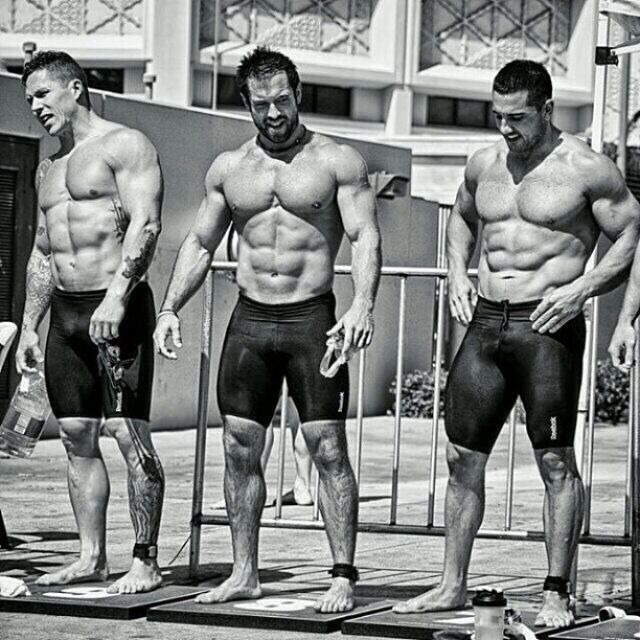
A ‘chipper’ is a format most commonly associated with CrossFit. And much like its famous 21-15-9 rep scheme, it turns traditional gym logic slightly on its head, and may just explain the well-built physiques of many top level CrossFitters who don't ostensibly focus on hypertrophy.
Instead of prescribing five sets of ten, a chipper simply gives you one overall target: 50 reps.
Your job is just to get there.
You might open with 15 reps, rest, hit another ten, then eight. As fatigue mounts, you’ll find yourself working in fives, threes and perhaps even twos, taking short breaks whenever form falters before getting back to work.
You simply keep ‘chipping away’ until the job is done.
There are no prescribed sets. No prescribed rest periods. Just a rep target, a suitable weight and the expectation that you complete the work in as little time as possible – without your technique falling apart.
Simple.
But done right, definitely not easy.
Exactly what we’re looking for.
Why Do Chippers Work So Well?
Think about what happens across those 50 reps.
Your opening set might take you close to failure. You rest just long enough to recover, then go again. That next set takes you back towards the same point. You recover briefly, then repeat.
As the workout continues and fatigue accumulates, your sets naturally become shorter – but more and more of the 'micro-sets’ you perform and the reps within take place close to failure.
In effect, you’ve accidentally turned the workout into one enormous rest-pause set.
Those brief breaks allow just enough recovery to keep producing good reps, without giving your muscles time to completely recover. The result is a lot of work packed into a very small window, a lot of reps performed in that proximity-to-failure zone, a boatload of ‘metabolic stress’, and if you’ve picked the right weight, tonnes of mechanical tension– all ingredients associated with muscle growth.
You’re essentially speed-running your way through a high number of hard, hypertrophy-friendly reps.
The catch?
It’s absolutely brutal. Sorry.
How Do You Use Chippers to Build Muscle?
For muscle-building movements, choose a weight that you could perform for more than ten reps while fresh, but no more than 15-20.
Then pick your target.
A more conservative target of 25 to 30 total reps works well for heavier compound exercises such as squats and deadlifts. 40-50 reps works well for compound movements that aren’t overly taxing across your entire body and use slightly lighter loads (think bench press, shoulder press and lunges). For lighter accessory movements, bodyweight moves and smaller muscle groups – your biceps, for example – you could push that target as high as 100.
Start working. Rest when you need to. Then get back to it.
The aim isn’t to hit complete failure and spend five minutes staring into the middle distance. You should rest just long enough to keep your form sharp and your sets productive.
As a rough rule, once you’re struggling to hit three to five good reps, take a break. But don’t rest for so long that you come back and suddenly feel fresh enough to repeat your opening set.
The discomfort is kind of the point.
How Do You Progress a Chipper Workout?
The beauty of the chipper is that progression is built directly into the format.
Repeat the same movements, using the same weights, and track how you perform.
Can you reach 50 reps in less time? Can you do it with fewer breaks? Are your sets getting bigger?
Once you can smash through your total in only two or three large sets, it’s probably time to increase the weight and start chipping away all over again.
For overall weekly volume, aim for somewhere in the region of 200-300 reps per body part, split across your training however makes sense.
That could mean several smaller 30-rep chippers. A handful of 50s. Or, for lighter movements, the occasional 100-rep death march.
Do Chippers Explain the Build of Elite CrossFitters?
It's certainly plausible, although the 'elite' part of that equation will always selects for athletes with the greatest muscle-building potential, they can thank their parents for that one.
That aside, much of the training performed by high level CrossFit competitors isn't simply engine work. It's heavy, high-density resistance training performed under accumulating fatigue, with minimal recovery between efforts. In other words, they're often doing something bodybuilders have deliberately programmed for decades: packing a lot of hard work into a very short period of time.
Chipper Workouts
Full-Body Chipper Workout
Choose weights that allow you to do more than ten reps in your first set, but no more than twenty. Rest as necessary to keep your form tight, and allow you to keep performing no less than 3-5 reps, but don’t rest for so long that your reps for each set begin to climb back up.
1/ Pull-Up x 50
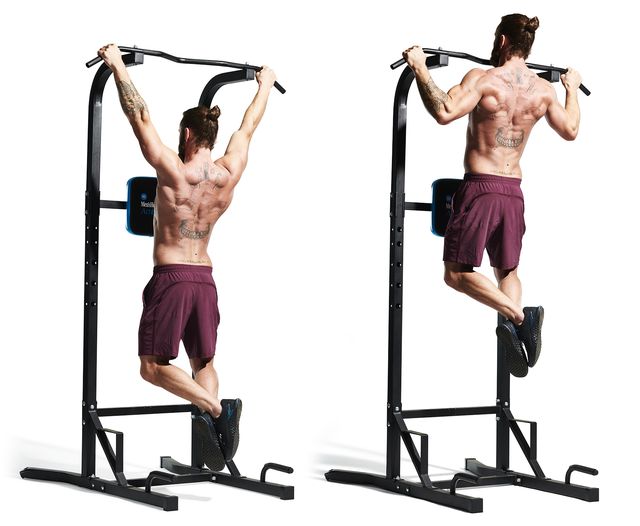
Grasp a pull-up bar with an overhand grip over shoulder-width apart, lift your feet from the floor, hanging freely with straight arms. (A) Pull yourself up by flexing the elbows while pinching your shoulder blades together. When your chin passes the bar, (B) pause before lowering to the starting position. If you struggle to do more than 8-10 pull-ups in a row, use a band for assistance. Rest as you need to in order to keep your form sharp, but not so long that the first few reps begin to become ‘easy’ again.
2/ Push Press x 75
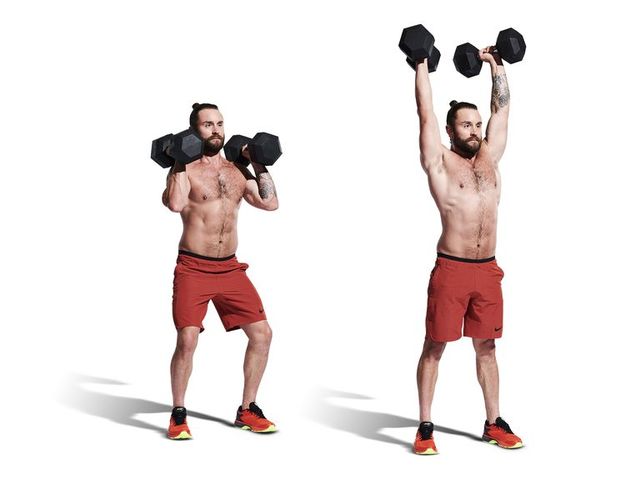
Clean your dumbbells onto your shoulders, palms facing in. Take a deep breath to help brace your core. (A) Dip at the knees and use your legs to help (B) press your dumbbells overhead. Lower under slow control to your shoulders and repeat. For maximum growth, ensure you’re lowering your dumbbells slowly on each rep.
3/ Front Squat x 100
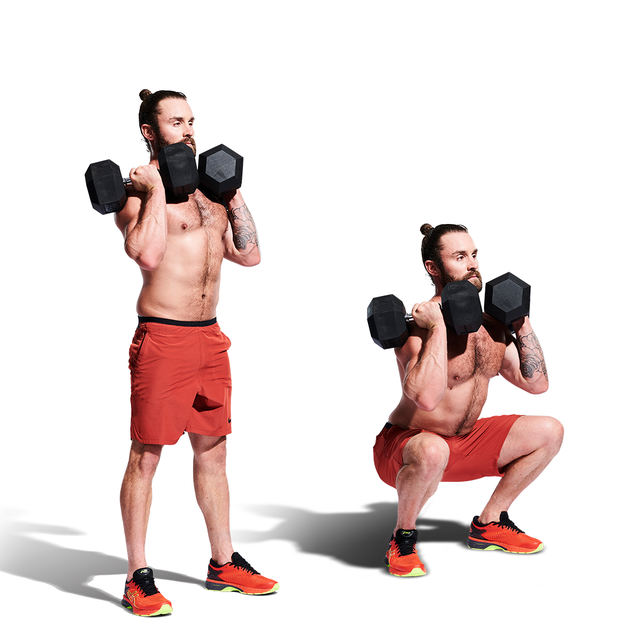
Once you’ve completed your presses perform your squats by cleaning the bells back onto the front of your shoulders (A). From here, drop into a deep squat, until your the crease of your hips passes below your knees (B), before driving back up. Keep your torso as upright as possible throughout, and keep control of that descent.
Upper-Body Chipper Workout
Choose weights that allow you to do more than ten reps in your first set, but no more than twenty. Rest as necessary to keep your form tight, and allow you to keep performing no less than 3-5 reps, but don’t rest for so long that your reps for each set begin to climb back up.
1/ Dumbbell Z-Press x 50
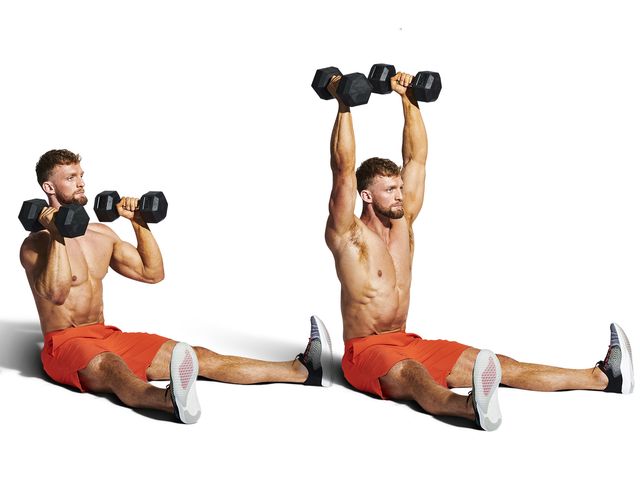
Take a seat on the floor with your legs outstretched and a pair of dumbbells on your shoulders. (A) Take a breath and brace your core, keeping your torso upright press your dumbbells overhead (B). Lower under control to your shoulders. When you can no longer lock the weights out overhead, or control their descent, take a short rest and continue.
2/ Bent-Over Row x 50
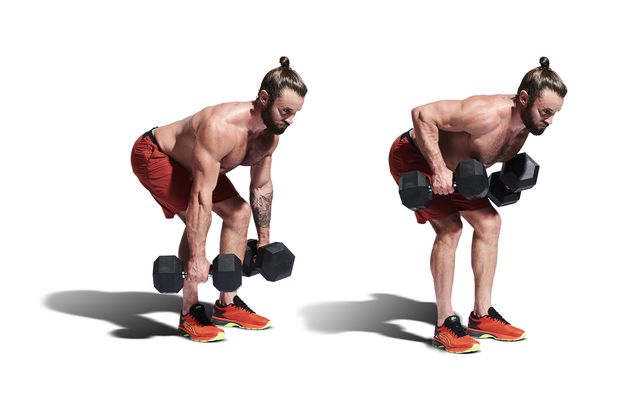
Hold your dumbbells at your sides and hinge at the hips until your chest is parallel to the floor, dumbbells hanging at your shins (A). Maintaining a flat back, row both dumbbells towards your hips (B), squeeze here, then lower under control to the start before repeating. Control the tempo both up and down and focus on finding and ‘feeling’ your lats.
3. Dumbbell Bench Press x 100
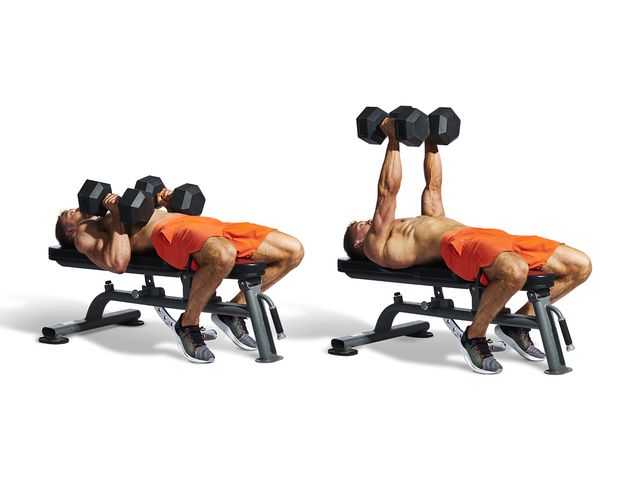
Lay flat on a bench, your knees bent, pushing your feet into the floors. Press a pair of dumbbells into the air, locking out your elbows (A). Lower the bells slowly until they touch your chest (B) keep your elbows at 45 degree angle, pause here before explosively pressing back up. Repeat.
4. Dumbbell Hang Cleans x 100
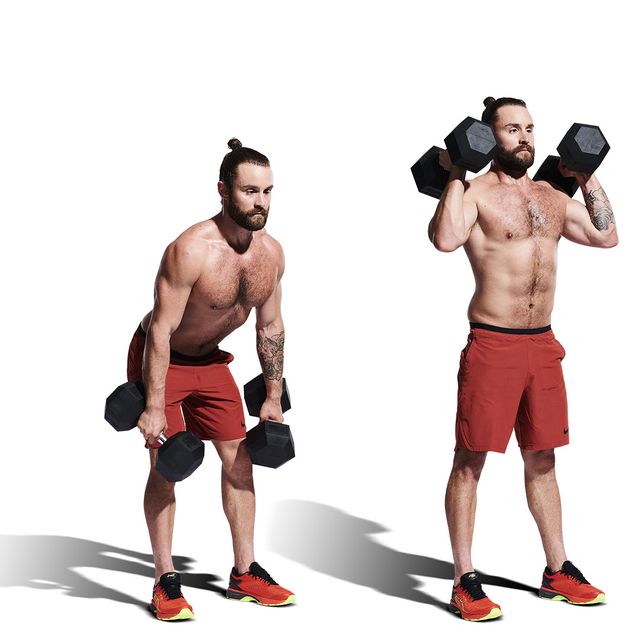
Stand up and hold your dumbbells at your side. Hinge at the hips to lower them to your knees (A). Stand back up with a slight jump, using the momentum to pull the dumbbells on to your shoulders (B). Stand up straight, then lower under control to your sides and repeat. Keep the ‘pull’ up explosive, but control the descent to add size to your biceps.
Lower-Body Chipper Workout
Choose weights that allow you to do more than ten reps in your first set, but no more than twenty. Rest as necessary to keep your form tight, and allow you to keep performing no less than 3-5 reps, but don’t rest for so long that your reps for each set begin to climb back up.
1/ Front Squat x 50
Clean your dumbbells onto the front of your shoulders (A). From here, drop into a deep squat, until your the crease of your hips passes below your knees (B), before driving back up. Keep your torso as upright as possible throughout, and keep control of that descent.
2/ Dumbbell Romanian Deadlift x 75
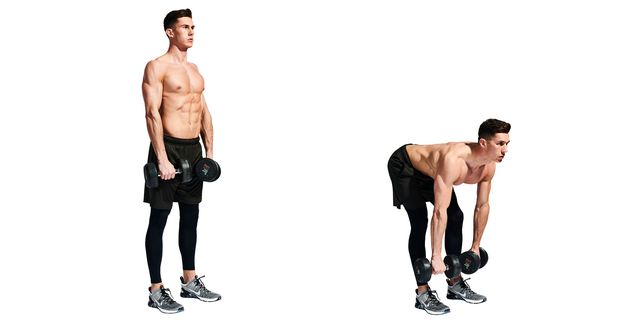
Stand tall with a your of dumbbells at your sides, feet at shoulder width and glutes tensed (A). With a slight bend in the knees, push your hips back and slowly lower the bells towards the ground (B), pinching your shoulders back and maintaining a flat back. When you feel a stretch in your hamstrings, pause and explosively return to and upright position.
3/ Alternating Reverse Lunge x 100 (Total)
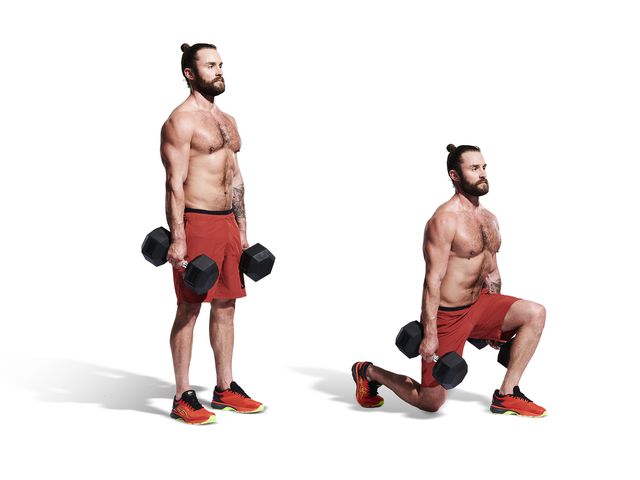
Stand tall after your deadlifts, hold your dumbbells with straight arms by your sides (A). Keeping your chest up at all times, take a step backward with one leg, bending your front knee until the back knee touches the ground (B). Stand up explosively, pause and repeat with the other leg. Each leg equals one rep. Continue until you reach 100 total.
4/ Dumbbell Deadlift x 100
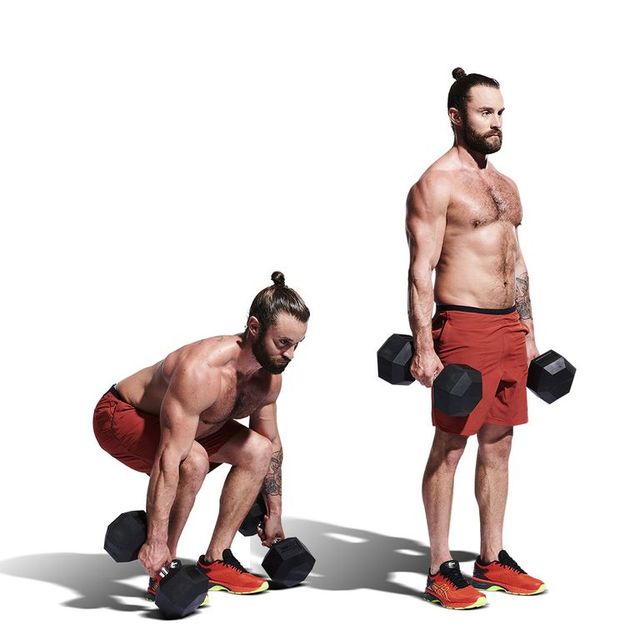
With your dumbbells on the floor just outside your feet, hinge down and grip them with a flat back and neutral spine (A). Engage your lats and stand upright, ‘pushing the ground away’ with your feet, squeezing your glutes at the top (B). Your arms should be hanging straight throughout this movement, think of them as hooks.


