Mastering the push-up is a rite of passage for many men. And it can be a game changer: it's simple, brutally effective and can be done almost anywhere. But how many of us bother to find its opposite?
And no, as effective as they are, we're not talking about pull-ups.
According to fitness educator and YouTuber Adam Sinicki – better known as The Bioneer – the humble inverted row is 'the perfect counter to the push-up'. And it's a movement he believes 'belongs in everybody's arsenal', despite being one of the most overlooked exercises in training.
What Is An Inverted Row?
Also known as the bodyweight row or Australian push-up (because you do them from down under, get it?), the movement involves hanging beneath a low bar, rings or even a sturdy table, keeping your body rigid and pulling your chest towards your hands. At first glance, it looks like an upside-down push-up – and that's exactly the point.
'It is literally like a push-up but upside down,' says Sinicki in a video on the benefits of the bodyweight move. 'You're pulling yourself up instead of down.'
Inverted Row Benefits
Modern training is dominated by pressing – push-ups, bench presses, overhead presses – and even if we try to balance this with pull-ups and lat pulldowns, horizontal pulling still often gets left behind.
What to read next
Rows help restore that balance by building the lats, rhomboids, traps and biceps while giving your shoulders a healthier ratio of pulling to pushing work.
And there's another reason they're so useful: accessibility.
'A lot of people actually can't do a single pull-up or a single chin-up,' says Sinicki. 'This is a fantastic progression towards that.'
If pull-ups remain stubbornly out of reach, inverted rows let you train the same muscles with a smaller percentage of your bodyweight.
Better still, they're endlessly scalable. Move your feet closer to the bar (or raise the bar) to make them easier, elevate your feet to make them harder, or use them as a mechanical drop set after pull-ups to squeeze extra work out of tired muscles.

But it's what happens below the shoulders and away from the back that really sets inverted rows apart, even from chin-ups.
'The real power of this movement comes from the fact that it's also a fantastic core strength and core stability exercise,' Sinicki explains.
Unlike a plank, which primarily asks your trunk to resist extension, the inverted row forces the muscles running up the back of your body – particularly the spinal erectors – to keep your torso rigid while gravity tries to fold you in the opposite direction.
It's a subtle difference, but an important one if you spend the majority of your day hunched over a laptop.
In the same way the movement you’re performing is the opposite of a push-up, the position you’re forced to hold is the opposite of a plank.
'We actually need more strength that way,' says Sinicki, arguing that building the posterior chain's endurance may help you stay upright for longer and improve resilience when lifting, carrying or simply moving through daily life.
The exercise also doubles as an opportunity to improve scapular control. Rather than hanging passively at the bottom of each rep, actively drawing the shoulder blades back teaches scapular retraction – a quality that carries over into stronger pulling mechanics and more advanced calisthenics skills.
Perhaps the biggest endorsement, though, is how little you need to get started. Rings are great, but a low bar, dip bars or even the underside of a sturdy table will do the job.
As Sinicki puts it: 'It's something I really think that pretty much everyone has access to.' And if your programme already contains plenty of pushing, there's a good chance it's exactly what it's been missing.
The Muscles Worked by an Inverted Row
- Latissimus dorsi (lats) are responsible for pulling your torso towards the bar.
- Rhomboids retract the shoulder blades, helping improve posture and upper-back strength.
- Middle and lower trapezius stabilise the shoulder blades and assist with scapular retraction throughout each rep.
- Posterior deltoids (rear shoulders) support the pulling movement and contribute to shoulder stability.
- Biceps flex the elbow to help complete each repetition.
- The forearms and grip muscles work isometrically to maintain your hold on the bar, rings or handles.
- Erector spinae keep the spine rigid, making the inverted row an effective posterior-core exercise, something Adam Sinicki highlights as one of the movement's biggest advantages.
- Rectus abdominis, obliques and transverse abdominis brace the torso to prevent your hips from sagging and maintain a straight body position throughout.
- Glutes help keep the hips extended and the body locked into a rigid plank position from shoulders to heels.
How to Perform the Inverted Row
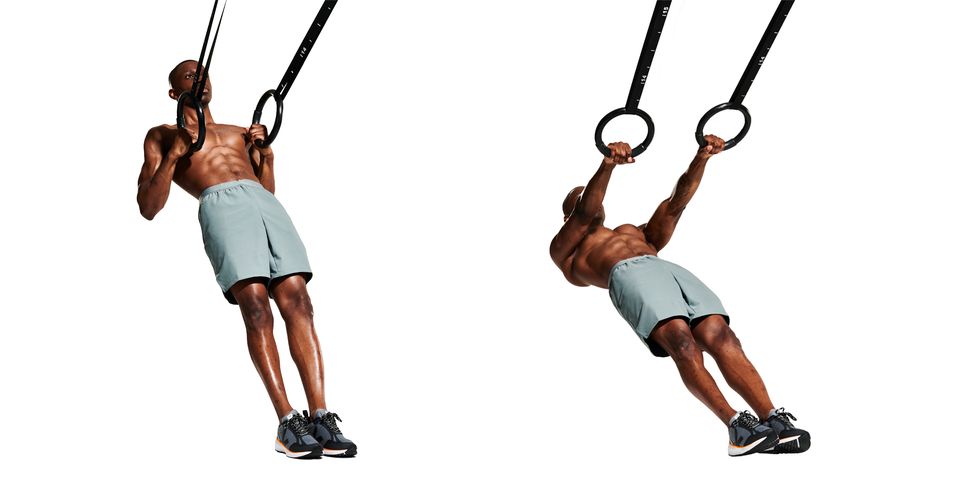
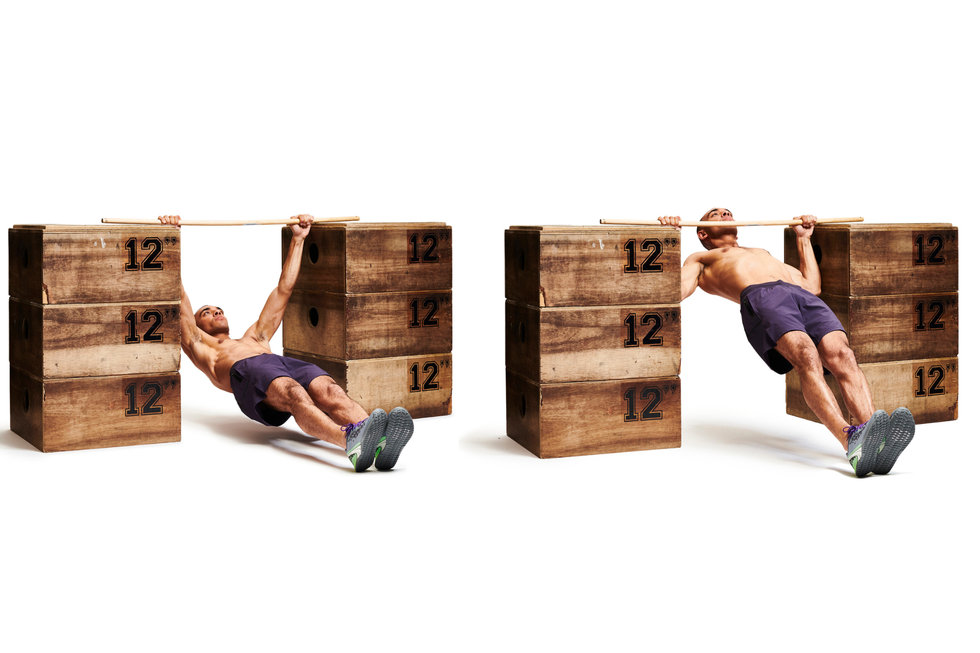
- Set a bar, pair of rings or suspension trainer at around waist height. Lie underneath and grip the bar or handles with a grip slightly over shoulder width apart.
- Extend your legs, dig your heels into the floor and brace your core so your body forms a straight line from shoulders to ankles.
- Pull your chest towards the bar by driving your elbows back and squeezing your shoulder blades together.
- Pause briefly at the top, then lower yourself under control until your arms are fully extended before repeating.
As Adam Sinicki points out, avoid simply 'letting the shoulder blades sag' at the bottom – use the movement to actively train scapular retraction on every rep. Work to maintain that rigid ‘inverted plank’ position throughout.
How to Scale and Progress
One of the inverted row's biggest strengths is how easily it can be adapted to any ability level. If you're just starting out, raise the bar or stand more upright, changing the angle so that you're lifting less of your bodyweight. As you get stronger, gradually lower the bar or elevate your feet on a bench to increase the load.
If you're working towards your first pull-up, Sinicki recommends using inverted rows as a progression, or even as a mechanical drop set: perform as many pull-ups as possible, then immediately continue your set with inverted rows.
Advanced trainees can increase the challenge further with paused reps, one-arm variations or anti-rotation rows, where you resist twisting through the torso throughout each repetition. You can even have a partner put weight plates on your lap or torso as you perform reps to add resistance.
If there’s one thing Kori Sampson knows, it’s how to optimise your body composition for performance. To tap into his knowledge as an elite athlete and coach, we asked him to create a 4-week plan to help you move faster, recover quicker and keep pushing when the fatigue sets in – all while improving your muscle-to-fat ratio.
Ready to build muscle, burn fat and come out the other side looking, feeling and performing better? CLICK HERE to get 14 days of free access to the plan via the Men’s Health app.