
Dips have often been hailed as the ‘squat of the upper body’. That’s rarefied air for a bodyweight movement, which are too often treated as also-rans: good-enough alternatives for when you don’t have access to a gym, rather than serious muscle-building movements in their own right.
But in my opinion, dips are one of, if not the, most powerful upper-body builders you can perform. In fact, if you were only ever going to use one pressing movement to build your chest – and with all due respect to the bench press here – it should probably be the dip.
They’re not just brutally effective chest builders, either. They’ll blow up your triceps, strengthen your shoulders and, because they require little more than two parallel surfaces, make for an incredibly portable muscle builder if you’re training on the go.
As a side note: at one point in my life I had no access to a gym whatsoever. I bought an old Zimmer frame from a Salvation Army charity shop and used it to perform dips, alongside daily pull-ups from my loft hatch. I saw some pretty good gains from those two movements alone.
All of this is to say: don’t underestimate the dip.
Below, we break down exactly what makes dips so effective, the muscles they work, how to build up to your first few reps and how to progress them once bodyweight becomes too easy.
What to read next
What Are the Benefits of Dips?
1. They Build Serious Chest Muscle
There aren’t many bodyweight exercises that allow you to load the pecs as heavily as dips.
Unlike press-ups, where a proportion of your bodyweight remains supported by your feet, dips ask your chest, shoulders and triceps to move almost all of your mass through space. Once bodyweight becomes easy, you can simply hang additional weight from a dipping belt, chuck on a weight vest or hold a dumbbell between your feet and keep progressing.
That makes dips less of a ‘bodyweight alternative’ and more of a legitimate heavy pressing movement.
Lean your torso slightly forwards, allow your elbows to travel naturally and descend under control, and you’ll place plenty of tension through the pecs – particularly around the lower and sternal fibres.
2. They’ll Blow Up Your Triceps
Dips aren’t called a compound exercise for nothing.
As your elbows extend to drive you back towards the top of each rep, your triceps are forced to work hard. Keep your torso slightly more upright and your elbows tucked closer to your sides and you can bias them even further.
This also makes dips a particularly efficient exercise when time is tight. Rather than performing separate chest and triceps exercises, you’re hitting both hard with one movement.
And unlike many triceps isolation exercises, dips allow you to eventually work with some serious loads.
3. They Build Your Shoulders, Too
Your anterior delts – the muscles at the fronts of your shoulders – contribute significantly to the pressing action of the dip.
That means your chest and triceps might get top billing, but your shoulders aren’t getting the afternoon off.
Performed through a controlled, comfortable range of motion, dips offer another way of adding pressing volume to your programme without simply piling on more bench presses and overhead presses.
4. They’re Idiot-Proof to Progress
One of the biggest criticisms levelled at bodyweight training is that progressive overload eventually becomes difficult. But not with dips.
Can’t perform one yet? Use your feet for assistance, employ resistance bands, perform slow negatives or use an assisted dip machine. Once you can hit clean sets at bodyweight, start adding load.
A dipping belt and a few plates can turn what started as a simple calisthenics exercise into a genuinely heavy strength movement. Build up slowly enough and weighted dips can become one of the cornerstone lifts in your upper-body training.
5. They Build Relative Strength
Dips demand that you move your own body through space. This is a skill worth mastering.
Being able to bench press a heavy barbell is impressive, obviously. Being able to control and propel your own bodyweight is a slightly different expression of strength – and one that tends to carry over well into sports, calisthenics and other bodyweight movements.
Get strong enough to perform high-rep dips or heavily weighted versions and you’ll have built a fairly formidable combination of strength and body control.
6. You Can Perform Them Almost Anywhere
Gym dip station. Parallel bars in the park. Gymnastics rings. Two sturdy boxes. The backs of two chairs in a hotel room. Even a charity-shop Zimmer frame.
Once you know what you’re looking for, dips are one of the easiest heavy-ish upper-body movements to recreate outside of a traditional gym.
That makes them particularly useful when you’re travelling, training outdoors or simply trying to build a minimalist programme.

What Muscles Do Dips Work?
Dips primarily target:
Pectoralis major: your chest muscles, particularly when you lean slightly forwards
Triceps: responsible for extending your elbows as you press upwards
Anterior delts: the fronts of your shoulders, which assist with the pressing movement
Your core, upper back, forearms and grip also have to work to stabilise your body during each rep.
Small changes in technique can alter where you feel the movement most. A slight forward lean in your torso tends to increase the contribution of your chest, whereas remaining more upright generally shifts more work towards the triceps.
That doesn’t mean you need to turn dips into two completely different exercises. Find a strong, comfortable position, control each rep and let the muscles do their job.
How to Do Dips
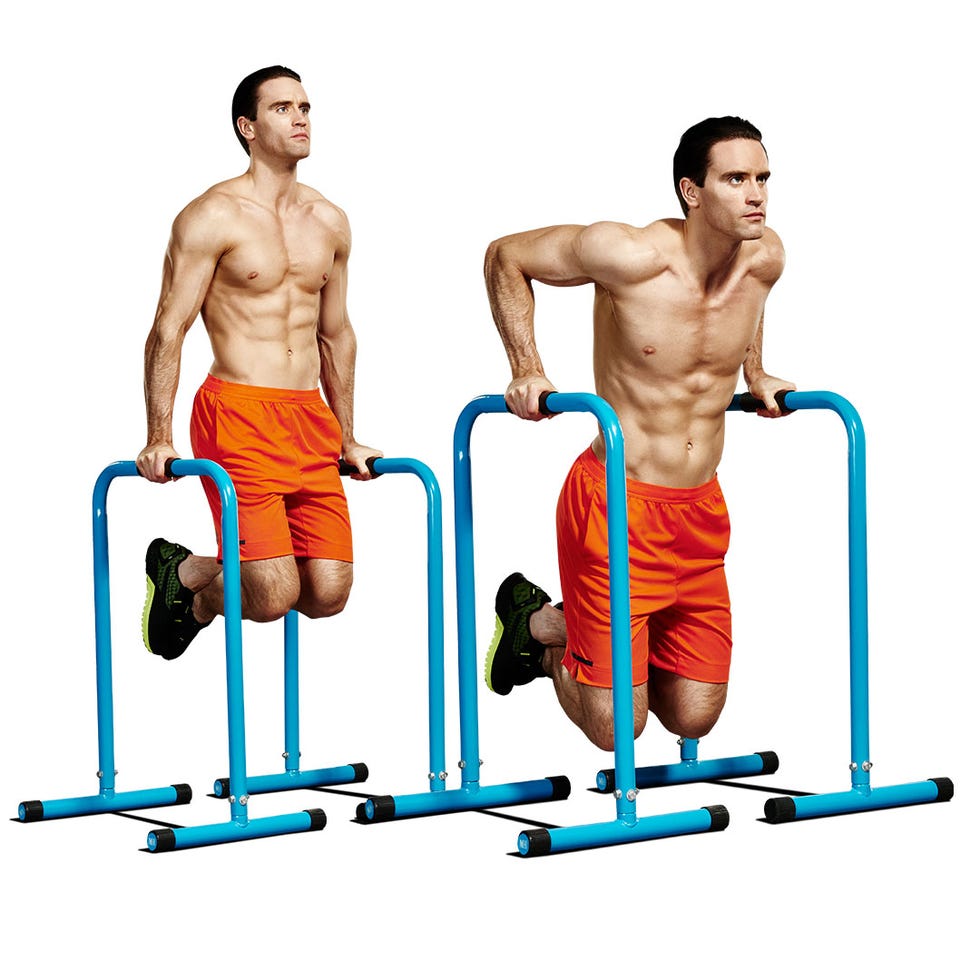
- Jump or step onto a set of parallel bars with your arms locked out and your hands underneath your shoulders.
- Brace your abs and glutes and keep your chest proud.
- Bend at the elbows and slowly lower your body towards the floor.
- Allow your torso to lean slightly forwards if you’re looking to emphasise your chest.
- Descend as deeply as you comfortably can until you feel a deep stretch in your pecs.
- Press the bars away explosively, extending your elbows until you return to the top.
- Squeeze your triceps hard at the top of each rep to lock in that lockout.
- Avoid bouncing out of the bottom or shrugging your shoulders towards your ears.
How to Build Up to Your First Dip
If you can’t perform a full dip yet, you don’t need to avoid the movement altogether.
Start with assisted dips, using either a machine or a resistance band to remove some of your bodyweight.
You can also perform eccentric dips. Step into the top position, then lift your feet and lower yourself as slowly as possible – aiming for three to five seconds – before putting your feet back down, stepping back into the top position and repeating.
Build these into your programme two or three times per week and gradually reduce the assistance until your first clean bodyweight rep arrives.
Once you can perform one, start accumulating reps. Five sets of two become five sets of three, and so on.
How to Make Dips Harder
Once you can comfortably perform 10-15 controlled reps with your own bodyweight, it might be time to up the ante.
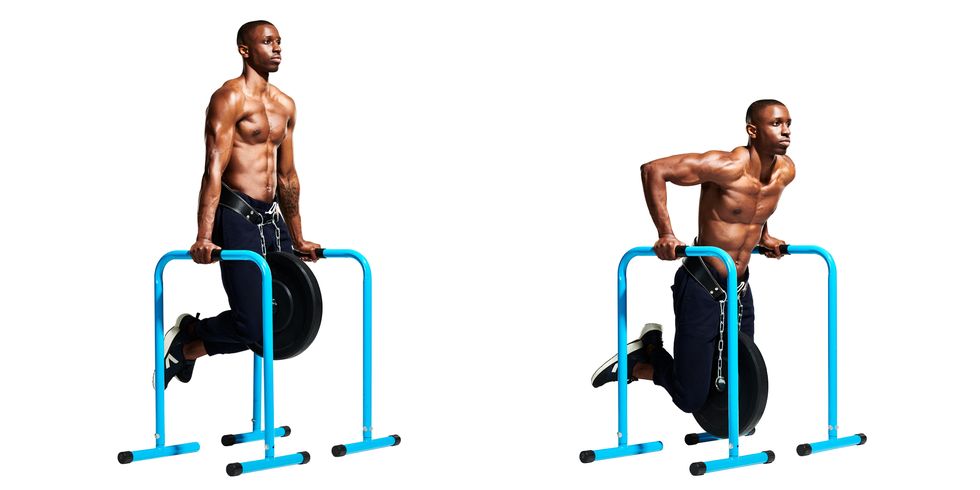
Weighted Dips
Attach a weight plate to a dipping belt, grip a dumbbell between your feet or wear a weighted vest.
Keep your reps lower – somewhere in the 5-10 range – and gradually increase the load over time.
Tempo Dips
Take three to five seconds to lower into every repetition, pause briefly at the bottom, then drive back up. This provides your muscles with plenty of extra time under tension, which increases the demand of each rep.
Paused Dips
Hold the bottom position for two to three seconds before pressing upwards. This removes momentum and forces you to generate force from a dead stop.
Ring Dips
Gym rings or suspension trainers introduce an enormous stability demand and immediately humble even strong dippers.
Master regular parallel-bar dips before graduating to these.
If there’s one thing Kori Sampson knows, it’s how to optimise your body composition for performance. To tap into his knowledge as an elite athlete and coach, we asked him to create a 4-week plan to help you move faster, recover quicker and keep pushing when the fatigue sets in – all while improving your muscle-to-fat ratio.
Ready to build muscle, burn fat and come out the other side looking, feeling and performing better? Click here to get 14 days of free access to the plan via the Men’s Health app.


