
Age isn't just a number. But turning 50 doesn't mean your best years in the gym are behind you, either. Train intelligently, prioritise the qualities that matter and there's no reason you can't keep building strength and muscle for decades to come.
Yes, staying strong and muscular can become more challenging as you get older. But challenging and impossible are two very different things.
Just look at the men in their 50s taking on Hyrox races and Ironman events, or those maintaining impressive levels of muscle well into their 50s and 60s.
MH cover star Lenny Kravitz is now in his 60s and still sporting a physique that regularly gets Instagram talking. Hugh Jackman continues to deadlift like Wolverine. Jason Statham is approaching 60 and still looks capable of handling most of his own fight scenes.
Your own pursuit of muscle and strength doesn't need to end at the half-century mark, either. You may need to rethink some of the ways you train and pay more attention to recovery, but that doesn't mean swapping the weights room for gentle exercise.
‘You don’t have to change everything you’re doing.’ says former bodybuilder Bryan Krahn, C.S.C.S. ‘Just work smart.’
Here's how.

Step 1: Change Your Training Mindset
If you're still approaching every workout exactly as you did in your 20s, it may be time to make some adjustments. And even if you're nowhere near 50 yet, building these habits now could help keep you training for longer.
Make Dumbbells Your Friend
The barbell may be a strength-training staple, but it also locks both hands into a fixed position. Dumbbells allow each arm to move independently and give you greater freedom to find a comfortable range of motion.
That can make dumbbell presses, rows and other unilateral variations useful options as you get older, particularly if certain barbell movements no longer feel as comfortable as they once did.
You don't need to abandon the barbell altogether. Think of dumbbells as another tool for continuing to train hard while working around your individual mobility and injury history.
Don't Ignore Isolation Exercises
Big compound movements such as squats, presses and deadlifts deserve a place in most strength programmes, but smaller bodybuilding-style exercises can be useful, too.
Movements such as biceps curls, lateral raises and triceps extensions allow you to target individual muscle groups without creating the same systemic fatigue as heavy compound lifts.
Use them to add muscle-building volume without turning every workout into an endurance event.
Work Hard, Recover Hard
Your ability to recover from demanding training may change as you get older, which makes what you do between sessions increasingly important.
Trainer Bobby Maximus, author of Maximus Body, has spoken about placing greater emphasis on recovery as he's aged.
That doesn't mean you need to spend twice as long foam rolling as you do lifting. But sleep, nutrition, mobility work and properly programmed rest days become increasingly difficult to ignore if you want to keep performing.
Know When Enough Is Enough
An extra round of burpees today isn't particularly useful if it compromises your next three training sessions.
‘Your work capacity is starting to decline,’ says Krahn, ‘along with your ability to recuperate.’
Rather than adding volume for the sake of it, give your workouts clear parameters. That might mean limiting a session to 45-60 minutes or setting a target number of quality working sets.
Do the work that matters, then recover.
Step 2: Fight Age-Related Muscle Loss
One of the biggest physical challenges as you age is sarcopenia – the gradual age-related loss of skeletal muscle mass.
Research suggests muscle mass can begin declining from your 30s onwards, making resistance training increasingly important as the decades pass.
Fortunately, muscle loss isn't something you simply have to accept.
Train for Power, Too
Building strength matters, but veteran muscle researcher Brad Schoenfeld, PhD, argues that maintaining power – your ability to produce force quickly – deserves attention as well.
Strength might determine whether you can lift a particular weight. Power determines how quickly you can produce that force.
You can introduce power work by using lighter loads and moving them with intent. Schoenfeld suggests 3 sets of 6 reps, taking around two seconds to lower the weight before accelerating it upwards as quickly as you can with good form.
Explosive movements don't need to mean highly technical Olympic lifts, either. Jumps, throws and appropriately loaded presses can all help you train the quality.
Eat Enough Protein
Training provides the stimulus for your muscles to adapt, but you still need the nutritional building blocks to support that process.
Schoenfeld recommends consuming around 35-40g of protein per meal.
‘Most people,’ he says, ‘simply don’t get sufficient protein intake.’
Spread your protein across the day and prioritise high-quality sources alongside an overall diet that supports your training goals.
Step 3: Don't Neglect the Small Stuff
The big lifts may get most of the attention, but smaller movements can help strengthen areas that support your training.
‘Subtle exercises make a world of difference for injury prevention, superior conditioning, and max performance,’ says trainer Kirk Charles, who's in his 60s.
Here are three worth considering.
Elevated Hip Bridge Hold
This movement challenges your hamstrings and glutes while requiring very little equipment.
Lie on your back with your heels on a chair, toes pointing towards the ceiling and knees slightly bent. Brace your core, drive your heels into the chair and raise your hips until your knees, hips and shoulders form a straight line.
Hold for 20-30 seconds while squeezing your hamstrings and glutes. That's one rep. Aim for five.
Pallof Press
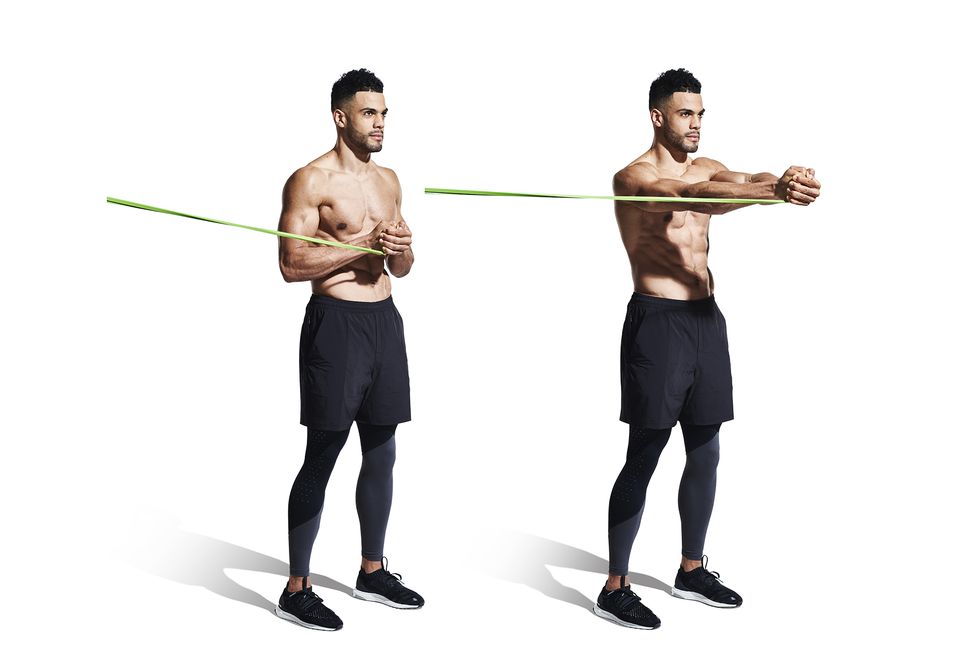
The Pallof press challenges your core's ability to resist rotation.
Anchor a resistance band to a fixed point just below shoulder height. Hold the band with both hands at your chest and turn so one shoulder faces the anchor point. Step away until there's tension in the band.
Brace your core and extend your arms directly in front of you without allowing your torso to rotate. Hold for two seconds, then return your hands to your chest.
Aim for 3 sets of 12-15 reps on each side.
Resistance Band Pull-Apart
Stand tall holding a light resistance band in both hands with your arms extended in front of you and a slight bend in your elbows.
Keeping your arms roughly parallel to the floor, pull the band apart until your arms are out to your sides, squeezing your shoulder blades together. Pause, then return under control.
Aim for 3 sets of 15 reps.
Step 4: Choose Exercises You Can Keep Progressing
You don't get bonus points for performing the most complicated exercise in the gym.
The goal is to find movements you can perform comfortably, progressively overload and continue using over the long term.
3 Moves to Keep
Romanian Deadlift
Not everyone has the mobility to comfortably deadlift from the floor. Romanian deadlifts allow you to begin from standing and hinge only as far as your mobility allows.
Hold your weights in front of your thighs, push your hips backwards and lower the load while maintaining a strong torso position.
Stop when you feel a significant stretch through your hamstrings, then drive your hips forwards to stand.
Floor Press
The floor press provides many of the muscle-building benefits of a dumbbell or barbell bench press while limiting how far your upper arms can travel behind your torso.
That reduced range of motion can make it a useful pressing option for lifters who find deep bench pressing uncomfortable.
Hollow Hold
This gymnastics staple challenges your core without requiring any equipment.
Lie on your back and press your lower back firmly into the floor.
Raise your legs and shoulder blades while keeping your core braced, holding the position without allowing your lower back to lift.
3 Moves to Modify
Max-Height Box Jump
Box jumps are useful for developing lower-body power, but you don't need to chase increasingly ridiculous box heights to benefit.
Use a height you can land on comfortably and consistently. The quality and explosiveness of the jump matter more than whether you can pull your knees high enough to clear a box for Instagram.
Wide-Grip Pull-Up

If wide-grip pull-ups feel uncomfortable on your shoulders, try a neutral grip with your hands around shoulder-width apart.
You'll still challenge your lats and upper back while using a position that many lifters find more comfortable.
Barbell and Dumbbell Military Press

If you don't have the shoulder mobility to comfortably press directly overhead, don't force it.
The landmine press is a useful alternative, allowing you to press upwards and forwards rather than finishing with the weight directly above your head.
The Bottom Line
Turning 50 doesn't require you to completely reinvent the way you train.
The fundamentals still work: challenge your muscles, progressively increase the demands you place on them, eat enough protein and give yourself enough time to recover.
The difference is that longevity starts to matter more. Choosing movements that agree with your body, maintaining power as well as strength and resisting the temptation to bury yourself in every workout can help you keep making progress without constantly paying for it afterwards.
Train hard. Just make sure you're training in a way that allows you to come back and do it again.

If there’s one thing Kori Sampson knows, it’s how to optimise your body composition for performance. To tap into his knowledge as an elite athlete and coach, we asked him to create a 4-week plan to help you move faster, recover quicker and keep pushing when the fatigue sets in – all while improving your muscle-to-fat ratio.
Ready to build muscle, burn fat and come out the other side looking, feeling and performing better? Click here to get 14 days of free access to the plan via the Men’s Health app.


