Reviewed by
 5 min read
FOR A LONG time, I saw straight razors more as weapons than as grooming tools. Maybe it was Sweeney Todd, maybe it was the ear-cutting scene from Reservoir Dogs, but these nifty blades always seemed more likely to slice skin than shave hair. That impression isn’t entirely inaccurate. Straight razors can nick you when used incorrectly, and they are certainly a weapon—just not in the way I initially thought. They don’t threaten your skin so much as your stubble and irritation, eliminating the shortcuts that lead to a bad shave. When used properly, a straight razor is the best weapon in your grooming arsenal for a precise, close shave.
Every form of shaving has its benefits. Electric razors are the quickest and require the least prep, cartridge razors are the most convenient and best for travel, and safety razors leave the least amount of ingrown hairs or irritation. However, none of these options can offer a shave as close as a straight razor. According to dermatologist Dr. David Johnson, MD, straight razors offer the closest shave possible because they slice hair exactly where it exits the follicle.
This comes down to the design. A straight razor is a single, exposed blade that folds into its handle and shaves without guards, cartridges, or moving parts. It gives the shaver complete control over angle and pressure, delivering unmatched precision when handled with care. I don’t use one every day because it’s the longest way of shaving. But it is the most rewarding, soothing shave you can have without going to the barber, so I use mine as a treat when I have an extra few minutes or want my skin to look especially smooth.
How Straight Razors Compare to Other Razor Types
Straight razors stand apart from other shavers because they strip the process down to its simplest, most effective form: one exposed blade, no guards, no cartridges, no motors—just your hand and the steel. Compared to cartridge razors, they don’t clog, tug, or rely on disposable heads, and they can deliver a closer shave with far less irritation once your technique is dialed in. Unlike electric razors, straight razors don’t compromise closeness for speed; they cut clean at skin level and leave sharper lines for beards and edges.
And while safety razors still rely on replaceable blades and a protective bar, straight razors reward patience with unmatched precision and longevity—one blade can last decades with proper care. Of course, there is a trade-off. Using a straight razor demands serious skill and practice to avoid cuts and skin irritation, along with the patience to get the job right, says dermatologist Dr. Brian Toy, MD. Plus, the blade requires regular maintenance with a honing stone and leather strop to keep it sharp. Dr. Toy adds that the full ritual—from lathering to shaving—takes time and makes straight razors impractical for travel.
Benefits of Straight Razor Shaving
The biggest benefit to using a straight blade is the closeness of the shave—you won’t find anything better in this department. But there are other boons, as well. According to Dr. Toy, those prone to irritation or ingrown hairs benefit the most from straight razor shaving. Similarly, men with curly hair who are more prone to pseudofolliculitis barbae, aka razor bumps, can also minimize this risk with a straight razor. That’s because the single, ultra-sharp blade cuts hair cleanly at the skin’s surface without tugging or ripping at the skin.
It offers greater control and precision, also making it ideal for detailed work like shaping beards and sideburns. There is a relaxing quality to straight razor shaving, as well. As someone who appreciates the ritual and craftsmanship involved in the process of a classic barbershop shave, it can often feel more like a calming, mindful practice rather than a chore to me. Additionally, straight razors are durable and waste-free, making them a cost-effective and more environmentally friendly option over time.
How to Shave With a Straight Razor
To protect and prepare your skin, straight razor shaving requires extensive prep, says Dr. Toy. First, a hot towel should be pressed to your face for several minutes to open the pores and soften the hair. Then, you’ll need to apply a healthy lather to avoid irritation and razor burn. These are helpful tools no matter what type of razor you’re using, but with a straight razor, they’re non-negotiables unless you want to look like the Joker. This is because the exposed blade offers no safety bar and relies on softened hair for a smooth cut, according to Dr. Johnson.
After this prep, he recommends holding the razor at roughly a 20 to 30° angle, using short, controlled strokes. Apply very light pressure and let the weight of the blade do the work, since pressing increases the risk of irritation or cuts. Keep the skin taut with your free hand throughout the shave to present a flat surface and allow the blade to glide cleanly. Applying an aftershave balm or lotion will then calm the skin and further minimize razor burn.
The Best Straight Razors
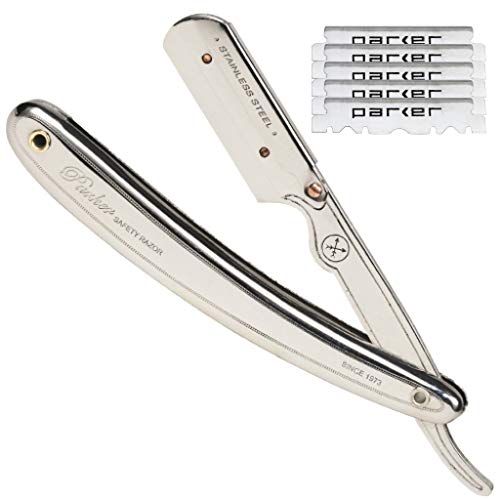
If you’ve never used a straight razor, deciding which to buy can be just as overwhelming as the process itself. This is a grooming tool you really don’t want to roll the dice on because a shoddy razor won’t perform much better than a kitchen knife. The Parker SR1 is our top choice for a straight razor because it’s equipped with a solid stainless-steel build that adds reassuring weight and control. Plus, there is a secure clip-to-close blade system and rounded blade exposure that reduces slips and nicks. On the budget side, the Equinox straight razor proves you don’t need to spend big to get a reliable, barber-quality shave.
It’s also great for beginners because its design is somewhere between a safety razor and a straight razor, with replaceable steel blades that you toss after a few shaves rather than needing to sharpen. There is an easy-open blade guard that makes these blade changes effortless, and it comes with 100 included blades, which is enough for at least 200 shaves. On the other end of the spectrum, The Feather Artist Club razor is the best premium option. Its fixed stainless-steel body and non-folding resin handle deliver exceptional stability and control, while the guarded blade system and touch-free replacements make it as safe and refined as it is razor-sharp.


Meet the Experts
- Dr. David Johnson, MD, board-certified dermatologist and co-founder of RedliteX.
- Dr. Brian Toy, MD, board-certified attending dermatologist at Providence Mission Hospital and a Clinical Professor in the School of Medicine at the University of Southern California.
More of Our Favorite Shavers and Trimmers
How to Trim Your Neck Beard | How to Groom Body Hair | How to Cut Your Own Hair |How to Trim Your Beard | How to Trim Nose Hair | How to Maintain Your Trimmer | Best Beard Trimmers | Best Nose Hair Trimmers | Pubic Hair Trimmers | Best Hair Clippers | Best Cordless Clippers | Best Back Shavers | Best Head Shavers | Best Body Groomers | Best Razors | Best Electric Razors
Shop All the Men's Health Training Guides

Men's Health Muscle After 40 At Home

Men's Health 28-Day Belly Fat Burner Workout

Men's Health Weight Loss After 40

Men's Health No Gym Required: Kettlebells

Men's Health 6-Week Lean Muscle Level-up

Men's Health 90-Day Transformation Challenge: Abs

Men's Health Unstoppable After 40

Men's Health The Lose Your Gut Guide
Sean Zucker is the Grooming and Reviews Editor at Men's Health. He brings over half a decade of experience covering health, wellness, and lifestyle. When Sean's not writing about hair products, you can find him running for exercise, or toward the nearest food truck.
Christian is the Style and Reviews Director at Men's Health and Women’s Health, where he oversees shopping and style content for both brands. He started his magazine career as an accessories assistant at Vogue, and has since held editorial roles at Tatler Asia and The Manual. When he’s not online shopping, you can find him on long walks with his two corgis.