Why do six-packs look so different from one person to the next? We posed the question to Dean Somerset, C.S.C.S., an exercise physiologist in Edmonton, Alberta, Canada.
Like cleft chins, hair colour and finger length, your abs are largely determined by your genes, says Somerset. If your mum, dad, grandma or grandpa are lean enough to show a six-pack – which typically means body fat of around 12 per cent or lower – you’ll probably notice similarities between theirs and yours.
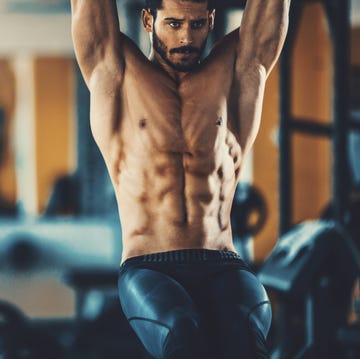
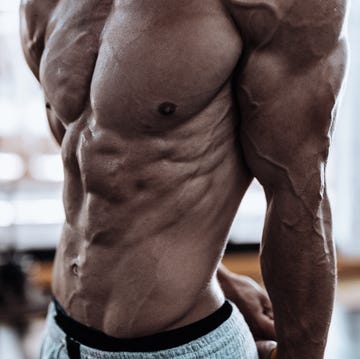
Maybe your abs are sharply defined, popping out like cobblestones. Or maybe they’re less distinct, resembling a smoother brick wall. The difference comes down to the size of your abdominal muscle bellies and the length of your tendons, explains Somerset.
What Determines Your Six-Pack Shape?
Let’s start with the muscle belly – the thickest part of the muscle. ‘Some people are born with thicker ones,’ says Somerset. ‘This can make the abs look more pronounced since there’s a higher peak on each one.’
Guys who look like they lift heavy despite never picking up a barbell are often blessed with these types of muscle bellies. It’s easier to see their abs because the highest point of the muscle is fuller, he explains. If you have thinner muscle bellies, on the other hand, your abs will appear flatter, because the peak of each abdominal muscle is lower.
Your tendons – which attach muscle to bone or muscle to muscle – also play a big role in how your abs look. They can determine whether your abs appear further apart or closer together. If you’re born with longer tendons, there will be larger gaps between each muscle; shorter tendons mean smaller gaps.
What to read next
To put this in perspective, think about your calves. Do they sit high on the back of your leg and look like cannonballs? Then you likely have a longer tendon running from your ankle to the muscle. If your calf takes up more of your lower leg, you have a shorter tendon.
As for uneven or asymmetrical abs, that’s genetic too, says Somerset. ‘We see crooked abs in cultures all around the world, so there’s probably no evolutionary reason for them,’ he explains. It’s simply passed down from generation to generation, like attached or unattached earlobes.

Can You Change the Shape of Your Abs?
In some cases, though, training can influence how your six-pack looks. If you perform a lot of rotational movements – like repeatedly throwing a baseball – you may develop a visibly tilted torso or diagonal-looking muscles. One side becomes more developed than the other, causing the abdominal region to shift slightly. ‘It’s your body adapting so you can throw better,’ he says.
Bodybuilders, meanwhile, want their abs to look three-dimensional on stage. When prepping for competition, they often use shorter-range movements at higher volumes to build a higher peak in the muscle bellies, says Somerset. One example: squeezing the abs as hard as possible at the end of each crunch.
Powerlifters, on the other hand, aren’t concerned with aesthetics – only performance. That’s why they use high-pressure breathing techniques to generate maximum force. This can result in thicker, denser abdominal walls with less visible separation, which is why many powerlifters appear more ‘blocky’ through the midsection.
‘A powerlifter needs an abdominal wall that’s strong enough to handle massive loads,’ says Somerset. Without it, they risk injuries such as hernia or diastasis recti – a tear in the tissue above the belly button that connects the two sides of the abs.
The Bottom Line
Ultimately, the way your abs look comes down largely to genetics – from the shape of your muscle bellies to the spacing created by your tendons. While training can influence size, density and, to a degree, symmetry, it won’t completely change your natural structure. Focus on lowering body fat, building core strength and staying consistent – that’s what will make the biggest visible difference.