6 min read
IN ONE CORNER of fitness Instagram, there is all-everything bodybuilder Chris Bumstead, admitting that he’s “relearning how to move like a human again” after years of slow, controlled hypertrophy-focused exercises that made him stiff. In another, there are influencers Jason and Lauren Pak, constantly reminding everyone that solely doing bodybuilding workouts would leave “serious gaps” in anyone’s training regimen and proclaiming that “function > aesthetics.”
Welcome to the latest chapter in the ever-changing, often-overly-polarizing fitness landscape. Depending on what your algorithm feeds you or the company you keep, you just might think there’s a problem with heading to the gym with purely aesthetic goals—that it’s somehow wrong to want to build bigger arms or carve washboard abs rather than functional strength. This line of thinking holds that people with these objectives over-obsess over the muscles they can see in the mirror (a.k.a “mirror muscles”), which isn’t good for your longevity and certainly won’t help you to be a better athlete.
Except there’s nothing wrong with what we’re calling “mirror muscle strength,” and focusing on it actually has more benefits than just your vanity. Could it really be that bad to be motivated by the prospect of looking a little more like a Marvel superhero? No, says trainer Don Saladino (who’s worked with such superhero actors as Sebastian Stan and Ryan Reynolds). “I think whether you’re training for functional sport or training just for aesthetics, there is a high level of benefit for that in correlation to longevity—because muscle is the organ of longevity.”
Why Function and Aesthetics Aren’t So Separate
TRANSLATION: EVEN IF you’re not hitting the gym thinking about how you move and how you feel, as long as you’re following the basic rules of strength training (think: progressive overload), you’re very likely honing the qualities that will improve longevity. That’s partly because our “mirror muscles” are actually more important to the way we move and function than some trainers want to admit.
Building big biceps and forearms, for example, will supercharge your grip strength, a research-backed indicator of longevity. The secret to the V-taper that action figures and Chris Hemsworth (and action figures of Chris Hemsworth) have? That’s actually about building major back muscle, which can help bulletproof your shoulders against injury. And the rise of the term “hockey butt” is all about the popularity of big glutes – which just happen to be the engine for all athleticism, too.
For all the talk of training to move laterally and rotate, said Dr. Pat Davidson in a recent episode of MH’s Strong Talk podcast, you need to build the muscles on the your front side (abs, chest, biceps, and quads among them) and back side (lats, glutes, hamstrings) to dominate how your body stands up to gravity.
Essentially, training for aesthetics and training for function have plenty in common, especially for gym beginners. Only at very advanced training levels (think: Chris Bumstead) is there a difference. Saladino argues that even the small muscles typically trained for aesthetics play key supporting roles in the larger multi-joint moves that trainers consider “functional”. Why else do powerlifters chasing bench press gains spend time training their triceps? (Those triceps help push you out of a chair, too, by the way.)
So why all the hate on going into the gym to train mirror muscles? Peloton instructor Andy Speer says training your “mirror muscles” gets a bad rap. And that just may be because it’s easy to get caught up in, say, biceps curls and never do the more taxing exercises that round out your overall fitness (and hit your entire Strengthspan, the spectrum of physical capacities you should be including in your workouts for healthy aging). “There's absolutely nothing wrong with working parts of your body that you feel like you want to improve upon,” says Speer. “But if all I'm doing is chest pressing and curls again and again, things are going to go poorly in the near future, and your shoulders aren’t going to be happy, and you're going to have no leg strength when you get older.”
At the end of the day, don’t overthink the whole debate about why you train. Whatever gets you in the gym has you moving, and that’s your biggest win. That works for normal guys like Peter Elias, a 53-year-old software salesman from new Jersey who’s lifted weights his entire life. Sure, his goals are about being fit for golf and “fit for life.” But what gets him back in the gym whenever his busy work schedule gets in the way?
Simple: An accidental glance at his reflection after a few days away from the gym. “As much as I care about mobility and athletic performance, I still love to see strong pecs and biceps when I look in the mirror,” he says. “If I don’t, I’m going to do something about it.”
And that’s as good a motivation as any.
3 Moves That Hit Your Mirror Muscles—And More
THE GOOD NEWS: the path to moving better and building pure strength and intersects a lot more with mirror muscle training than most guys realize. Here are three moves that will build the mirror muscles you want—and help build your entire Strengthspan, too. Aim to do each at least once a week, and you’ll cover many of your movement bases, while also building toward the aesthetic look that it’s completely okay to want, too.
Half-Kneeling Shoulder Press
Why: The half-kneeling shoulder press blasts shoulders and triceps—and it just may be the most underrated six-pack abs exercise you’ll find out there too, says MH fitness director Ebenezer Samuel, C.S.C.S. “Your abs have to stabilize your spine during each press,” he says. That’s not just so you don’t arch your back, either; as the weight gets heavier, your torso may want to tip from one side to the other. Your core prevents that from happening.
How to Do It:
- Get into a half-kneeling position on the ground, holding the kettlebells in each hand. Squeeze your core and glutes to make it a strong position.
- Raise both kettlebells into the racked position, holding the handles and resting the weights on your forearms.
- Press both kettlebells straight up.
- Keep one arm extended and perform another press rep with the other. As you lower the single rep arm, bring the static arm down too.
- Repeat the double rep, then perform the single rep on the other side.
Sets and Reps: 3 sets of 8 reps per side.
Kettlebell Swing
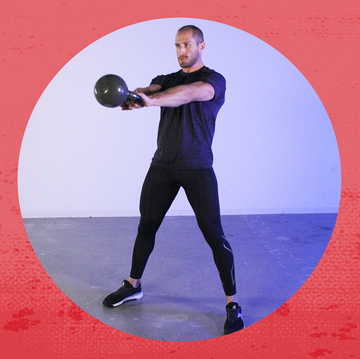
Why: Want glutes? This all-around move builds them, and it hits other aesthetic notes, too. “Your entire core is working to keep you stable and controlled on every swing,” says Samuel, “and swing for long enough, and your forearms will feel it, too.”
It’s also training your glutes at a vastly different speed than many other more classic glute builders, like Romanian deadlifts and hip thrusts. You’re generating serious force—fast. This explosive movement subtly improves your athleticism. And because you can string together high rep counts with swings you’ll quietly challenge your aerobic system too.
How to Do It:
- Start standing with your feet slightly wider than hip-width apart, with the kettlebell on the ground in front of you.
- Push you butt back, then lean over to grip the bell's handle. Hold on tightly.
- Squeeze your shoulder blades, then shift your arms to turn the pits of your elbows outward. Squeeze your abs to create tension. Keep your eyes on the floor to maintain a neutral spine.
- "Hike" the weight back between your legs, keeping your knees slightly bent. Keep your arms straight.
- Stand straight up, locking your knees, and aggressively squeeze your glutes to perform the swing. Keep your arms loose, like ropes connecting yourself to the kettlebell. Don't aim for a certain point; allow the momentum to determine how high the bell goes.
- Allow the weight to fall back down, back through your legs.
Sets and Reps: End your workouts with 4 to 5 minutes of 40-seconds on, 20-off swing work.
Chinup
Why: “I consider this a mirror muscle move,” says Samuel, “because wide, strong lats are actually key to the aesthetic torso most guys want. They just often don’t realize that.” Chinups blast abs, forearms, biceps, and midback muscles on every rep. A bonus: You can do them anywhere. (Bonus: they’re having a moment right now.)
How to Do It:
- Get into a good hanging position with an underhand grip, squeezing your shoulders, abs, and glutes to maintain tension.
- Drive your elbows into your hips to pull yourself up to the bar. Continue until your head is above the bar, pausing briefly at the top.
- Lower back down until your elbows are extended, maintaining control of the position and keeping tension.
Sets and Reps: Aim for 3 sets of as many good-form reps as you can do