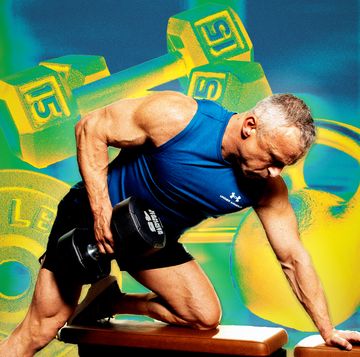
Building muscle after 60 isn’t just possible – it may be one of the most important things you can do for long-term health and independence.
According to physiotherapist Will Harlow, who specialises in helping adults over 50 improve strength and mobility, muscle loss accelerates significantly with age unless it’s actively challenged through training.
Speaking in a recent YouTube video, Harlow explained that adults over 60 commonly begin losing strength in several key muscle groups linked to balance, posture and everyday movement.
But the decline isn’t inevitable.
‘The body still responds to resistance training later in life,’ Harlow explains. ‘You just need to train the right areas consistently.’

Why Muscle Loss Accelerates After 60
Harlow says age-related muscle loss – known as sarcopenia – affects strength, balance and mobility as people get older.
What to read next
Research from Norton Healthcare has also highlighted how sarcopenia increases the risk of falls, loss of independence and reduced physical function in later life.
The good news, according to Harlow, is that strength training can significantly slow – and sometimes reverse – many of these effects.
‘The body still responds to resistance training later in life,’ he explains. ‘You just need to train the right areas consistently.’
The Muscle Groups Adults Over 60 Should Prioritise
Glutes
Harlow describes the glutes as one of the body’s most important structural support systems alongside the core.
Strong glutes help stabilise the hips, support posture and improve balance while walking or lifting objects. Weakness in this area often leads to instability, forward-leaning posture and difficulty standing up from chairs without assistance.
‘When the glutes weaken, the entire body becomes less stable,’ Harlow says.
Calves
The calf muscles play a major role in balance and forward movement.
According to Harlow, weak calves can reduce walking endurance, shorten stride length and make people feel less stable on their feet.
While many assume this decline is simply an unavoidable part of ageing, he says targeted strengthening work can make a significant difference.
Rotator Cuff Muscles
In the upper body, Harlow highlights the importance of the rotator cuff – the group of muscles and tendons responsible for shoulder stability.
Weakness in this area can make everyday tasks like reaching overhead, lifting objects or putting on a jacket increasingly uncomfortable.
Fortunately, Harlow says these muscles respond well to consistent strengthening exercises.
Core Strength
The core remains one of the most important areas to train after middle age.
‘Your core stabilises almost every movement you perform,’ says Harlow.
As people age, many stop training it altogether, which can increase instability and raise the risk of falls or injury – particularly during twisting or reaching movements.
Why Strength Training Matters More With Age
Harlow says the goal after 60 isn’t necessarily to look like a bodybuilder – it’s to maintain strength, independence and quality of life for as long as possible.
Still, transformations like the one that recently went viral online prove that building muscle later in life is absolutely possible with the right approach and consistency.
‘Ageing doesn’t mean you stop responding to training,’ Harlow says. ‘It just means your training needs to become more intentional.’