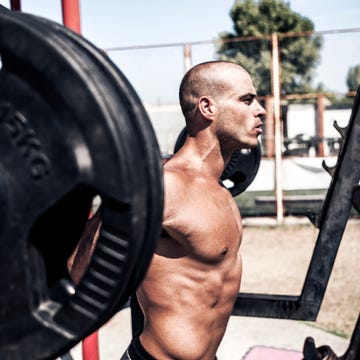
Strip away the tunics and Latin, and the ancient Roman legionary job description reads like a modern hybrid training plan: endurance under load, repeat-effort strength and the ability to stack challenges back-to-back without folding.
And this isn’t romanticising a brutal life after watching Gladiator one too many times. We have primary sources outlining exactly what recruits were expected to do, along with modern historians who’ve tried to recreate what that reality might have felt like.
The Loaded March
Vegetius, a high-ranking imperial official writing in late antiquity, compiled what he believed were Rome’s best military practices. His work reads like a training manual, detailing the standards he thought had helped Rome conquer a quarter of the known world.
At the centre of it all was the loaded march. A recruit was expected to cover 20 miles in five hours at the ‘military step’, and 24 miles in the same time at the faster ‘full step’.
That’s roughly a 7:46 min/km pace, for the Strava crowd. Not exactly a Sunday stroll.
Marching in formation at a set cadence for hours would be punishing on its own. Add the load each legionary was required to carry, and it becomes something else entirely.
What to read next
Vegetius cites a standard pack weighing around 43 Roman pounds, roughly 14kg. But that was just the essentials. Modern reconstructions of a legionary’s full kit, including armour, weapons and trenching tools, suggest marching loads may have reached 55kg, with more conservative estimates only 10kg lighter.
So now you’re looking at a near-marathon-distance ruck, completed in five hours, carrying up to 55kg. A brutal blend of strength, endurance and grit.
It’s no surprise Vegetius wrote that soldiers were selected for strength over height.
And that was just the start.
March, Build or Battle
Here’s what your modern rucking plan is probably missing. The Romans didn’t arrive at their destination and put their feet up. They dug trenches, hauled supplies, built fortifications or went straight into battle.
Ancient accounts describe Roman armies fortifying their camps as routine in hostile territory, often emphasising the speed with which they could construct walls and trenches immediately after marching. It puts your Hyrox sled pushes into perspective.
Workout: Build Modern-Day Roman Legionary Strength
The good news is you don’t need to march out to meet the Goths to build this kind of hybrid strength-endurance.
A structured carry-and-lift session can develop the kind of resilience that keeps you stronger for longer. Try this.
Part 1: The March
Complete a long-distance ruck. Start with a manageable load in a comfortable pack or weighted vest. Gradually build towards carrying around one-third of your bodyweight. Going much heavier offers diminishing returns and increases your risk of overuse injuries. This isn’t life or death.
One simple approach is a max-distance, time-capped format. Decide how long you have, set a timer for half that duration and march as far as possible. Then turn around and aim to return to your starting point before the timer runs out. Forty to 60 minutes is a solid starting framework.
Increase load when it feels comfortable, and add distance progressively.
Part 2: Build and Battle
As soon as you finish your march, drop the pack and move straight into a circuit of carries, conditioning and compound lifts. If you’re training at home, use your pack as resistance or invest in a heavy kettlebell or dumbbell.
Try This 20-Minute AMRAP
Complete as many rounds as possible in 20 minutes, maintaining solid form throughout
- 5 x Clean and Press (kettlebell, dumbbell, pack or weighted vest)
- 10 x Push-Up
- 20 x Reverse Lunge (total reps)
- 40m Loaded Carry (bear hug your pack, suitcase carry a kettlebell or farmers carry two dumbbells)

With almost 18 years in the health and fitness space as a personal trainer, nutritionist, breath coach and writer, Andrew has spent nearly half of his life exploring how to help people improve their bodies and minds.
As our fitness editor he prides himself on keeping Men’s Health at the forefront of reliable, relatable and credible fitness information, whether that’s through writing and testing thousands of workouts each year, taking deep dives into the science behind muscle building and fat loss or exploring the psychology of performance and recovery.
Whilst constantly updating his knowledge base with seminars and courses, Andrew is a lover of the practical as much as the theory and regularly puts his training to the test tackling everything from Crossfit and strongman competitions, to ultra marathons, to multiple 24 hour workout stints and (extremely unofficial) world record attempts.
You can find Andrew on Instagram at @theandrew.tracey, or simply hold up a sign for ‘free pizza’ and wait for him to appear.