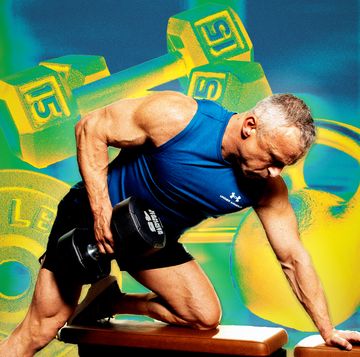
Six months ago, Men’s Health fitness adviser Bill Hartman, P.T., was like many of us: in decent enough shape, but heading in the wrong direction after years of eating on the go while working long hours. Sure, he trained hard a few days a week and ate healthy foods. ‘But I didn’t pay attention to portion sizes,’ he says. A snack of a handful of cashews, for example, often became five or six handfuls, leaving him with a 600-calorie hit.
With the big 5-0 approaching, Hartman, co-owner of IFAST Gym in Indianapolis, needed some inspiration.
‘Jack LaLanne would often do a big physical challenge on his birthday,’ he says. ‘I thought maybe I should do something a little crazy too.’
Hartman’s goal: to get shredded and regain the shape he was in back in his 20s, when he competed as a bodybuilder.
He would need to put in more effort this time around, because losing fat and building muscle becomes harder with every passing year. After 35, declining testosterone and a slowing metabolism add to the challenge. Still, the path to a bodybuilder physique remains the same: disciplined training and diet.
First, Hartman devised the perfect fitness plan. Next, he recruited his friend, Men’s Health nutrition adviser Mike Roussell, PhD, to build a nutrition programme that would satisfy his appetite and sculpt his core.
What to read next
‘Then it all came down to following the plans,’ says Hartman.
Now Hartman is down more than 25 pounds, and his body fat hovers around 7%. Losing fat and dropping weight also improved his general health by reducing inflammation and improving insulin sensitivity – two factors that become increasingly important as we age.
‘Smaller dogs live longer,’ says Hartman, pointing to nature for inspiration.
Want to get your edge back? Just follow the four fundamentals of Hartman’s programme.
The 4 Steps to a 5-0 Shred
Ease Into It
Many men think the only way to reveal their abs is to hammer the gym and slash calories. But if you do too much too soon, you risk burning muscle and mentally burning out.
‘If you go extreme right away and then stop progressing, where do you go from there?’ Roussell asks.
So start by cutting 200-300 calories a day from your diet. Stick with it. Once progress plateaus – usually after two to four weeks – cut another 200-300 calories and repeat.
Hartman, for example, started at 2,200 calories a day, then reduced intake to 2,000 before eventually finishing at 1,750.
Be Flexible in the Gym
A typical training programme prescribes a fixed number of sets, such as three or five. But because performance fluctuates based on factors like sleep and stress, that prescription may feel too hard or too easy on any given day.
That’s why Hartman based his programme around ‘autoregulation’ sets. Your reps stay the same, but the number of sets varies depending on performance. You perform as many sets as possible until form breaks down or strength drops off.
This approach does two things: it provides enough stimulus for progress while also preventing you from digging too deep and risking injury.
Keep Having Fun
Every Saturday for the past decade, Hartman has taken his gym’s interns out for lunch at a local Mexican restaurant to decompress and review the week.
‘Obviously the fajitas, margaritas and all the tortilla chips I could eat didn’t fly anymore,’ says Hartman.
So Roussell helped him find a meal that still worked within the plan: spicy chicken breast on a bed of greens.
‘Maintaining normal rituals during your diet is key to sustainability,’ says Roussell.
Plan Ahead
Midway through his transformation, Hartman had to travel to China for 10 days. He stayed on track by packing 24 protein bars, 10 packets of chicken jerky and four tins of cashews.
‘When you’re committed to a goal, your nutrition decisions need to be made beforehand,’ Roussell says.
At home, Hartman pinned his eating plan to the fridge so he and his wife could easily shop and cook around it.
‘She also lost weight,’ says Hartman.
Bonus Tip: Why Cardio Helps Fat Loss
Going flat-out in the gym six days a week may actually sabotage your progress.
Here’s why: your body needs time between hard sessions to recover and build muscle. If you limit that recovery by training intensely more than two days in a row, your muscles can’t rebuild properly. Instead, they just keep breaking down.
To support recovery between hard sessions, Hartman performed lower-intensity cardio workouts. These helped increase blood flow to his muscles and improve recovery.
Hit the stair climber or perform a bodyweight circuit of squats, step-ups, inverted rows and press-ups for 45-60 minutes at a conversational pace. Aim to keep your heart rate between 120 and 150 beats per minute.

The Exact Workout Hartman Used to Get Lean at 50
Hartman designed this workout plan to help him get ripped at – or even after – 50.
In this programme, you’ll train five days a week. On days one, three and five, you’ll complete strength sessions built around one primary lift followed by two circuits. Days two and four are dedicated to cardio and recovery.
The primary exercise on each lifting day uses ‘autoregulation’ sets. That means you’ll perform between three and six sets depending on how well you’re moving that day. If your form breaks down, the exercise is over. Some days you might hit six sets; other days only three.
The goal is to train hard enough to stimulate muscle growth without pushing yourself into excessive fatigue.
You can follow the programme for anywhere between four and 12 weeks.
Day 1
Primary Exercise: Barbell Floor Press
Sets: 3-6
Reps: 4 using a weight you could lift 6 times
Rest: 2-3 minutes
Circuit 1
- Dumbbell Alternating Low-Incline Bench Press
- Dumbbell Straight-Leg Deadlift
- Lat Pulldown
Reps: 6-8 each
Rest: 75 seconds
Rounds: As many as possible before form breaks down
Circuit 2
- Suitcase Carry
- Kettlebell Pullover
Reps: 8-10 each
Rest: 75 seconds
Rounds: 2
Day 2
Cardio
45-60 minutes at a conversational pace
Day 3
Primary Exercise: Chin-Up
Sets: 3-6
Reps: 4 using added weight you could lift 6 times
Rest: 2-3 minutes
Circuit 3
- Lat Pulldown
- Dumbbell Front Squat
- Standing Single-Arm Kettlebell Push
Reps: 6-8 each
Rest: 75 seconds
Rounds: As many as possible before form breaks down
Circuit 4
- Suitcase Carry
- Kettlebell Pullover
Reps: 8-10 each
Rest: 75 seconds
Rounds: 2
Day 4
Cardio
45-60 minutes at a conversational pace
Day 5
Primary Exercise: Deadlift
Sets: 3-6
Reps: 4 using a weight you could lift 6 times
Rest: 2-3 minutes
Circuit 5
- Single-Arm Dumbbell Row
- Dumbbell Alternating Low-Incline Bench Press
- High-Knee Step-Up
Reps: 6-8 each
Rest: 75 seconds
Rounds: As many as possible before form breaks down
Circuit 6
- Suitcase Carry
- Kettlebell Pullover
Reps: 8-10 each
Rest: 75 seconds
Rounds: 2
How to Do the Exercises
Barbell Floor Press
Lie on your back and hold a barbell above your chest with your arms straight and knees bent. Lower the barbell until your upper arms touch the floor. Pause and press the weight back up to the starting position. If you don’t want to lie on the floor, do a regular bench press.
Dumbbell Alternating Low-Incline Bench Press
Lie face up on an incline bench set to a low angle. Hold a pair of dumbbells above your chest with your arms straight and palms facing forward. Slowly lower your right arm to the side of your chest while keeping your left arm extended above your body. Press back up with your right arm, lower your left arm, and return to the starting position. That’s 1 rep.
Dumbbell Straight-Leg Deadlift
Hold a pair of dumbbells at arm’s length in front of your thighs. Without rounding your lower back, bend at your hips and lower your torso toward the floor. Pause and return to the starting position.
Lat Pulldown
Attach a lat pulldown handle to the high pulley of a cable station. Grab the handle and sit in front of the weight stack. Slowly pull the handle to your chest. Pause and slowly reverse the move.
Chin-Up
Hang at arm’s length from a chinup bar using an underhand, shoulder-width grip. This is the starting position. Pull your chest to the bar as fast as you can, pause, and take 2 seconds to lower yourself to the starting position.
Suitcase Carry
Grab a heavy dumbbell, hold it at your side, and walk. Keep your torso straight throughout. Walk 100 feet; then switch sides and walk the 100 feet back.
Dumbbell Front Squat
Hold a pair of dumbbells with your palms facing inward, upper arms perpendicular to the floor. Push your hips back and lower your body into a squat; then push back up.
Standing Single-Arm Kettlebell Push
Stand holding a kettlebell in your right hand with your arm bent, the kettlebell just outside your right shoulder. Extend your left hand out to the side. Press the weight overhead until your arm is straight; then lower it to the starting position. (You can use a dumbbell instead of a kettlebell.) Do all your reps; then switch hands and repeat. Don’t rest between sides.
Deadlift
Bend at your hips and knees and grab a barbell using an overhand grip, your arms just outside your legs. Now stand up, pulling the bar off the floor and thrusting your hips forward. Lower it back to the floor.
Single-Arm Dumbbell Row
Hold a dumbbell in your left hand and place your right hand and right knee on a flat bench. Lower your torso until it’s almost parallel to the floor. Let the dumbbell hang at arm’s length from your shoulder. Pull the dumbbell to the side of your chest. Pause and return to the start. Do all your reps, switch sides, and repeat.
High-Knee Step-Up
Grab a pair of dumbbells and place your left foot on a bench or step. Press through your left heel and slowly lift yourself onto the bench as you raise your right knee to a 90-degree angle. Take 2 seconds to lower your right foot back to the floor. Do all your reps, switch legs, and repeat.
Kettlebell Pullover
Lie on your back, holding a kettlebell by its horns above your chest with your arms straight. Bring your hips and knees to 90 degrees and feet together. Take in a big breath. As you breathe out, slowly lower the kettlebell directly behind your head, keeping your lower back on the floor. Pause; then breathe in as you pull it back up.

Michael Easter is a health and fitness writer, a visiting lecturer at UNLV, and the author of The Comfort Crisis.