
It's really starting to seem like 50 is the new 30. Or, at least, it is if you have a decent training plan, a handle on your nutrition and a very real desire not to go gentle into the good night (aka fossilise on the sofa after your mid-40s).
Over the last few years, a slew of famous men in their 50s, 60s, 70s and beyond have proved that the brief for midlife fitness has changed. We’re not just talking about ‘looking good for your age’, either. We’re talking physiques, performance markers and daily habits that would make many men in their mid-20s blush.
Ben Shephard has built more lean muscle at 50 than he had in his 30s. Paddy McGuinness got into the best shape of his life at 52. Ralph Fiennes turned up in his 60s looking like a Greek myth with a gym membership. David Beckham, Jason Statham, Colman Domingo, Gordon Ramsay, Ernie Hudson, J.K. Simmons and Arnold Schwarzenegger are all still putting in the work, too.
Here’s what 13 seriously fit famous men over 50 can teach the rest of us about training, eating and ageing well.
Ben Shephard, 50
Ben Shephard’s midlife fitness arc started long before his 50th birthday. As a younger presenter, seeing himself on screen was enough to make him realise he’d been relying on the easy confidence of youth, sport and natural fitness while the early signs of ‘booze bloat’ crept in. Years later, 50 days before turning 50, he set himself a new challenge: to see if he could match the shape he was in for his last Men’s Health cover back in 2012.

With long-time trainer Steve Coleman, Shephard’s training has been built around heavy, progressive resistance work, combining compound lifts, isolation exercises, eccentric loading, supersets and drop sets. In a typical week, he hits four big strength sessions, alongside cardio, and plenty of mobility.
What to read next
The nutrition has required the same discipline. He prioritises protein during the day so he can still enjoy family dinners, plans meals and workouts ahead, and has cut back on the random midweek beers. His biggest lesson? It’s not one magic exercise. It’s consistency.
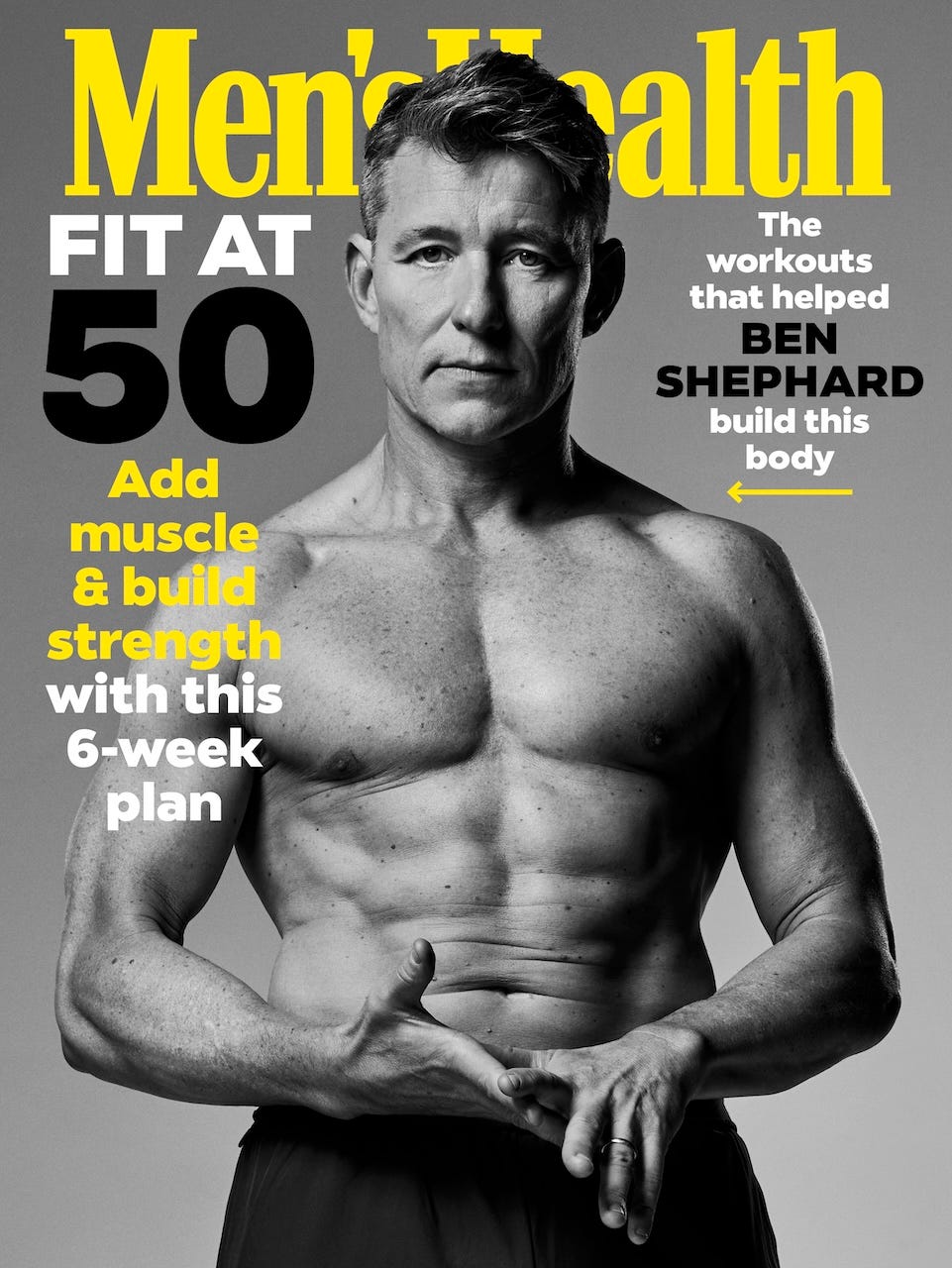
Sign up below to gain free access to our six-week Fit at 50 training plan, created by Shephard’s long-time coach Steve Coleman.
Click Here
Paddy McGuinness, 52
Paddy McGuinness didn’t slide gently into better habits. He deliberately let himself go – lasagne, pizza, kebabs, beer, the lot – then used 75 Hard to drag himself back out. He doesn’t recommend that bit, but the result was a full-scale body recomposition and a new relationship with routine.
During 75 Hard, McGuinness trained twice a day, drank nearly four litres of water, read daily, cut out alcohol and cheat meals, and took progress pictures. The habit that stuck hardest was brutally simple: at 6am, kit already laid out, 500ml of water with electrolytes, then 40 minutes walking on a curved treadmill. No music. No TV. Just him and the silence.

For his Men’s Health cover shoot, he brought in Steve Coleman, who programmed six full-body hypertrophy sessions a week, with daily steady-state walking to help drive fat loss. His diet became more precise, too: roughly 2,250 calories and around 200g of protein on training days. His point is the useful one: at 52, it’s attainable.

Sign up for 14 days free access to the MH app and read our guide to how best to do 75 Hard now.
Ralph Fiennes, 62
Ralph Fiennes didn’t get in shape to look like a superhero. In fact, for The Return, the target was much weirder – and much more interesting. Director Uberto Pasolini didn’t want a pumped-up gym body. He wanted Fiennes, playing Odysseus, to look like ‘a bit of old rope’: hardened, weathered, capable and lived-in.

The route there, however, still required serious graft. Under the guidance of personal trainer Dan Avasilcai, Fiennes followed a disciplined five-month training plan built around progressive weight training, regular running and a nutritional base of lean protein, complex carbohydrates and vegetables.
The end goal wasn’t beach muscle or social-media vascularity, but physical believability – a body that looked as though it had survived hardship, rather than one designed purely for a mirror selfie. At 62, Fiennes’ transformation is a reminder that training in later life doesn’t have to mean chasing size. It can mean building a body that looks – and more importantly, performs – like it still has a job to do.
Colman Domingo, 56
Colman Domingo’s approach to fitness in his 50s is refreshingly free of midlife panic. The Euphoria and Sing Sing actor did briefly wonder if his naturally lean frame needed a ‘boost’, even visiting a doctor to ask about testosterone therapy, only to be told his levels were as high as they were when he was 16.

Rather than chasing size, Domingo doubled down on longevity. For the past decade, he has trained with Vann Duke, founder of SecondHalf Fitness, a company focused on people over 50. These days, his workouts prioritise cardio, flexibility and recovery more than heavy lifting. Yoga, meditation, sauna and thermal pools all feature in the mix, especially when travel starts to bite.
His nutrition is similarly relaxed but not careless. Domingo still loves soul food, but after gaining weight for Netflix’s The Madness, he became more mindful of sugar, alcohol and carbs. His meals now usually centre on meat or fish and vegetables. He doesn’t count calories, he says – he ‘barters’ with them.
Gordon Ramsay, 59
Gordon Ramsay’s training journey began with a fairly brutal wake-up call. After years consumed by restaurants, pressure and work, he realised he was overweight and out of control.
Since then, he has become almost as well known for endurance graft as kitchen rage. Over the past decade, Ramsay has competed in half marathons, marathons, triathlons and Ironman events, using training as a way to claw back time for himself. These days, he wakes around 5.30am, heads out for a short run, does mobility or core work, and occasionally jumps on the Wattbike after long workdays. Weekends are when he tends to push harder, including sessions such as a 2,000m swim followed by an hour of strength work.
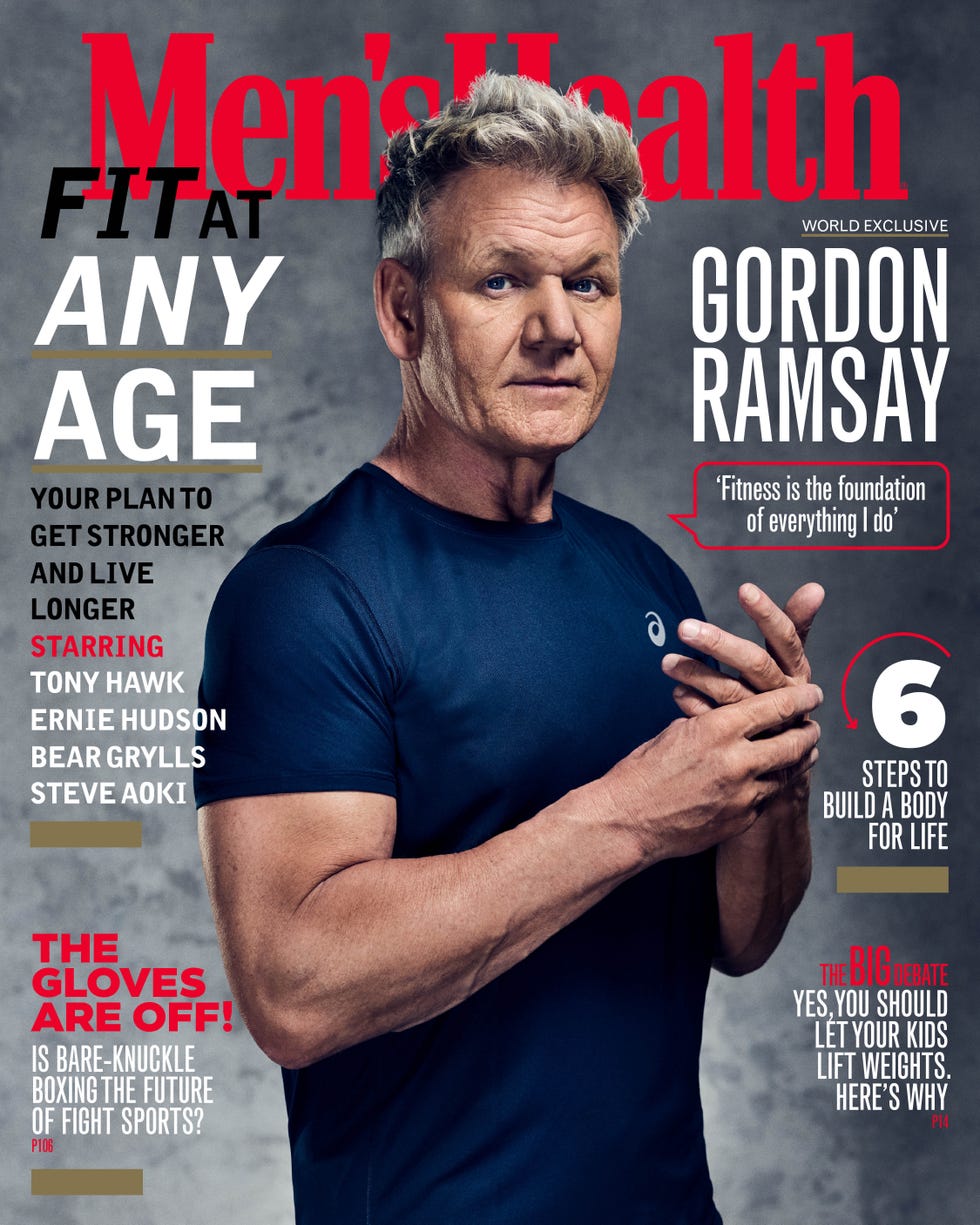
His non-negotiable? Twenty-five push-ups first thing in the morning. Nutrition-wise, he grazes on smaller portions, shares starters and desserts at family meals, leans on vegetables, soups, beans and salads, and fuels rides with porridge, plant-based protein shakes and fruit. Not exactly Hell’s Kitchen. More like disciplined chaos.
Tom Aikens, 55
Fine dining and fitness shouldn’t really work together. Long hours, constant stress and being surrounded by incredible food are not usually ingredients for a lean, durable body. Tom Aikens has made it work anyway.
The Michelin-starred chef says consistency is the secret. He schedules gym time during the week and keeps weekends for family. His weekly routine is structured and pragmatic: two weights days, two mobility, core and posture sessions, and one pure cardio session. He also stretches for an hour every morning after waking at 6am.

There’s a functional reason for all this. Chefs spend decades slouched over workbenches, and Aikens says years of chopping wore away the cartilage in his shoulder. Mobility work helped him avoid surgery and stay pain-free enough to keep working.
His fitness journey began after a phase of post-service blue cheese and beer gave him a belly. He trained to shift it, then went deep into endurance, including the Marathon des Sables. Food-wise, he uses intermittent fasting, skips breakfast and doesn’t eat the food he serves – staff meals are good enough.

Steve Coogan, 60
Steve Coogan isn’t selling himself as a gym-hardened action man, which is exactly why he belongs on this list. His version of fitness at 60 is less about abs and more about agency: still being able to do his own running, climb actual mountains and stay sharp enough to keep working at the level he wants.
While filming Legends, Coogan was offered a stand-in for a scene that required him to run across a dockyard at speed. After watching the double run, he decided he’d rather do it himself. That’s a pretty good midlife fitness test: not how you look under downlighting, but whether you can still back yourself when the director calls action.
He also celebrated his 60th birthday by climbing Kilimanjaro instead of throwing a huge party. He admits that, after your early 30s, you can’t get away with everything quite so easily, and he doesn’t consider himself a gym rat. But he does try to keep in shape.
A major part of that has been sobriety. Coogan says he is better at everything when he doesn’t drink – better at being a person, better at writing, better at life.
Ernie Hudson, 78
When Ernie Hudson appeared looking jacked to the gils on the Ghostbusters: Frozen Empire red carpet at 78, the internet had questions. The answer, as usual, was less exciting than people wanted. No secret longevity hacks, unfortunately, and no miracle diet. Just the basics, repeated for decades.

Hudson uses intermittent fasting and doesn’t usually eat before noon. His first meal tends to be oatmeal or smoked salmon and eggs. He avoids faddy diets and hard rules, largely because rules make him want to break them. His guiding principle now is simple: keep trying to be a little bit better.
Training-wise, he goes to Studio G Fitness three times a week, where he has trained for 25 years. He keeps sessions to an hour or less, working on strength, mobility and balance. When he can’t get to the gym, he still does at least 100 push-ups at home.
His hotel-room routine is pure gold: push-ups, bodyweight squats, a plank, abs and stretching. He walks everywhere he can, avoids going too heavy, and trains to keep his muscles from wasting away. Common sense, basically. But common sense done consistently.

J.K. Simmons, 69
J.K. Simmons didn’t get serious about fitness until his 50s. That should be comforting to anyone who thinks they’ve missed the boat. After getting badly out of shape, his wife introduced him to trainer Dana Perri, and in the year he turned 54, he lost 24kg. Since then, he has tried not to look back.
The viral image that made the internet notice was taken when he was 61: bearded, arm blaster on, curling dumbbells, biceps very much present and correct. But Simmons is clear that the goal now isn’t just movie muscle. It’s old-school hard work, nutrition and staying healthy.

For Red One, starring opposite Dwayne Johnson was motivation enough. His standard gym session is now around 60 minutes, though during hard movie prep it could stretch to two hours. He trains with moderate weights, doesn’t skip leg day and prioritises his lower body and core.
He also has no interest in ‘chemical help’. At his age, he says, it just doesn’t seem worth it. The lesson: start where you are, lift properly, eat well, and keep your weight range tighter than your excuses.
Jason Statham, 58
Jason Statham has the unfair advantage of being Jason Statham. But even allowing for the martial arts background, the diving career and the general aura of a man who could reverse-park a tank, his fitness at 58 is ridiculous.
For The Beekeeper, Statham worked with James Moontasri, a former UFC welterweight and two-time taekwondo national champion. Training began 12 weeks before filming and often started at 5am, blending jiu-jitsu, boxing, stunt drills and long technical sessions designed to make every kick, punch and movement look flawless on screen.
Moontasri says Statham stays in phenomenal shape year-round, which means the coach’s job is mostly about helping him execute what he already knows. That includes a serious base of bodyweight strength. Statham can apparently crush pull-ups and muscle-ups on gymnastics rings, and he has the ability to push himself hard in isolation.

His training is about authenticity. He wants to perform action properly, not rely on special effects or other people doing the hard bits. His nutrition has matured, too. The older he gets, the cleaner and smarter he eats.
David Beckham, 50
David Beckham spent two decades at the top of professional football, but his current training looks very different from the work that made him match-ready. At 50, he’s stronger through the upper body than he ever was as a player, and he credits long-time trainer Bobby Rich with changing the way he trains.
In his playing days, Beckham’s strength work was mostly lower-body focused. Since retiring, his training has become more full-body, built around big movement patterns and classic staples: bench presses, single-arm dumbbell rows, push-ups and pull-ups. The last two have become especially important. Beckham says he used to hate pull-ups and could manage only two or three, but Rich made him focus on press-ups and pull-ups until they became regular fixtures.

The goal now is to stay lean, strong and pain-free. Upper-body and core work help with the backaches he carries from football, and he admits he has added a bit of meat to his chest since retiring.
He also trains five or six days a week with Victoria, using the shared sessions as motivation. Recovery matters, too: acupuncture, cupping, sauna and ice baths all feature.

Arnold Schwarzenegger, 78
Arnie has trained through more lives than most men get to live: bodybuilding icon, Hollywood action hero, politician, newsletter philosopher, gym-world godfather. At 78, he is still training every day – not because he’s chasing another Mr Olympia title, but because it's what makes Arnold, Arnold.
His morning routine is a lesson is as wholesome as it is simple. He wakes up, starts the coffee, feeds the animals, drinks the coffee, gets on his bike, rides to the gym, trains, then rides to breakfast. Arnie doesn't negotiate with motivation, he just cracks on. Every day.
That’s the point. Schwarzenegger argues that routine saves mental energy. When the sequence is automatic, your body carries you into the work before your mind has time to start arguing.
His wider message on ageing is just as useful. Progress doesn’t need to mean smashing yourself. It means finding joy in the work, building habits that compound and turning up often enough that training becomes part of who you are. The Austrian Oak might be older now, but the roots are still deep.
Graham McTavish, 64
Graham McTavish’s job still asks a lot of his body. With roles in The Witcher, House of the Dragon, The Hobbit and Spartacus: House of Ashur, the 64-year-old actor is often dealing with weapon work, fight scenes and physically demanding shoots. His training has to support that.

McTavish has exercised for most of his life: long-distance cycling, running, squash, tennis and weight training. As he’s got older, his focus has shifted towards functional, dynamic movement, floor-based exercises and bodyweight work, with some weights mixed in. The goal is an overall fit and functional body that helps him both professionally and personally.
He trains for explosive power, deep tissue strength and adaptability. His cardio rotates between rowing, Tabata uphill runs and cycling.
His diet is structured but unfussy: pancakes or wholewheat bread with cottage cheese and yoghurt, turkey and avocado, protein shakes, fish, brown rice and vegetables.

If there’s one thing Kori Sampson knows, it’s how to optimise your body composition for performance. To tap into his knowledge as an elite athlete and coach, we asked him to create a 4-week plan to help you move faster, recover quicker and keep pushing when the fatigue sets in – all while improving your muscle-to-fat ratio.
Ready to build muscle, burn fat and come out the other side looking, feeling and performing better? Click here to get 14 days of free access to the plan via the Men’s Health app.

With almost 18 years in the health and fitness space as a personal trainer, nutritionist, breath coach and writer, Andrew has spent nearly half of his life exploring how to help people improve their bodies and minds.
As our fitness editor he prides himself on keeping Men’s Health at the forefront of reliable, relatable and credible fitness information, whether that’s through writing and testing thousands of workouts each year, taking deep dives into the science behind muscle building and fat loss or exploring the psychology of performance and recovery.
Whilst constantly updating his knowledge base with seminars and courses, Andrew is a lover of the practical as much as the theory and regularly puts his training to the test tackling everything from Crossfit and strongman competitions, to ultra marathons, to multiple 24 hour workout stints and (extremely unofficial) world record attempts.
You can find Andrew on Instagram at @theandrew.tracey, or simply hold up a sign for ‘free pizza’ and wait for him to appear.


