

Leafing through an old copy of Runner’s World, I came across a 2013 article by Adharanand Finn. It detailed the Running with the Kenyans author’s attempt to run a 5-minute mile (spoiler: he succeeded, running 4:54). Finn had been a decent middle-distance runner as a teenager and, having focused on the marathon as an adult, wanted to see if some of the old track speed still remained.
While my teenage years were not quite so athletic – I made the school cross-country team for the sole reason that I could be relied upon to bring in my PE kit – I too was looking to roll back the clock. Having turned 40 last year, I found myself succumbing to the narrative that I was slowing down. The data certainly suggested so. My marathon best of 2:58 was set way back in 2017 and I hadn’t run a PB over any distance in about five years. I needed a challenge – something to jolt me out of my midlife malaise. If Finn could run a sub-5 mile, maybe I could too…
How Hard Is it to Run a Sub-5 Mile?
When it comes to the mile, the famous digit is, of course, 4. It’s now been 70 years since Sir Roger Bannister broke the seemingly impossible 4-minute barrier for the distance. (Lesser reported, of course, is the fact that a few weeks later Diane Leather became the first woman to break the 5-minute barrier.)
Today, I’d say that the sub-5 mile is the middle-distance equivalent of the sub-3 marathon: a tough challenge that is nonetheless within the realms of possibility for quick men and very quick women.
The received wisdom tends to be that you need to be able to run a 5k in less than 18 minutes – and preferably closer to 17 – and be running at least 30 miles a week. (Despite the fact that it’s a relatively short distance, the mile is still primarily an aerobic event, so the long, slow stuff still has a role to play.) Oh, and it helps to be young – ideally in your 20s.
On paper, it was a big ask. I’d never run close to 17-flat for 5k, was logging closer to 25 miles a week than 30 and was 40 years old. Was I kidding myself?
How I Trained for a Sub-5 Mile
With age, however, comes experience. When looking at the sub-5 plan (see below) created for Finn by acclaimed middle-distance coach Trevor Painter, I knew that some adaptions would be needed if I were to avoid an express ticket to Injury Land.
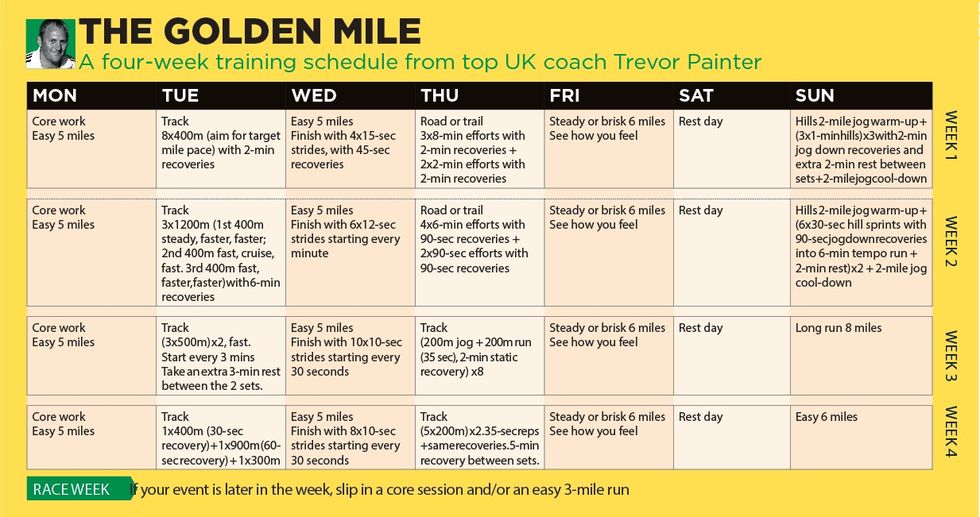
To move from running four times a week (three easy, one hard) to six times a week (three easy, three hard) would be too big a jump. My solution was to add a warm-up week to the schedule in which I’d reduce the number of reps in the speedwork sessions, before starting the plan proper. So, instead of running 8 x 400m in the first week, I ran 6 x 300m. Instead of running nine hill repeats, I ran six.
A quick word on that 8 x 400m session, which should be performed at target mile pace (75 seconds per lap or quicker) with 2-minute recoveries between sets. A little bit like how the Yasso 800s session is meant to be a predictor of marathon finishing time, the 8 x 400m session will give you an idea of whether your mile goal is realistic. If you can hit the times (or one or two seconds quicker), you may be able to run a sub-5 mile at the end of the training block. If you can’t, don’t despair – you just might need an extra couple of weeks. But I wouldn’t progress with this plan until you can nail that session.
Despite my sensible start to the training programme, my right hamstring was beginning to object to all this up-tempo running. So I contacted running physio Tom Goom, who suggested that I replace one of my twice-weekly strength routines (which included, among other things, heavy deadlifts) with some isometric hamstring moves such as glute bridges. The improvement was almost instant and meant that I completed every one of the plan’s high-quality sessions.
As for the easy and long runs, I attempted to run on soft surfaces as much as possible. There’s very little evidence to suggest that softer surfaces are kinder on joints, but the fact that so many elite runners tend to limit their miles on the road is good enough for me. Ditto for foam rolling: the science is split on its benefits, but I diligently did it three or four times a week and felt better for doing so.
The Power of the Group
The single smartest thing that you can do when training for a mile is to find some like-minded people to train with. Kipchoge has the NN Running Team. I had the slightly less renowned ‘Carpe Deep End’, a self-styled rabble consisting of Matt Weaver, a swift 56-year-old also targeting a sub-5 mile, and George Bull and Brendan Maton, who were hoping for sub-6. We only trained together once a week, for the crucial track intervals, but the sense of a shared goal helped to keep motivation high.

Even so, there’ll likely be moments in your mile training when you need to run hard without company. I remember a particularly nasty session – 10 x 200m, run at 35 seconds per 200m, with 35-second recoveries – that I performed alone early one morning at Crystal Palace track. It was unpleasant and intimidating, but if you’re serious about running sub-5, you turn up and you get it done.
I was back in the group for the final key session: 400m, 30-second rest, 900m, 60-seconds rest, 300m, all performed at target mile pace. For sessions such as this, as well as for the race itself, it’s essential to conduct a thorough warm-up. A couple of strides won’t cut it. I would jog to the track (about two miles), do about 6 x 100m strides at target pace, a bit of backwards running to switch on the glutes and some plyometric drills borrowed from the Ethiopians. That way, you’re primed and ready to run quickly from the off.
If at First You Don’t Succeed
Training had gone well, my hammy was playing ball, I’d even given up alcohol for a couple of weeks. It was time to give sub-5 a go. But the mile takes some mastering. Go out a little too hard or, in our case, a little too cautiously and you’re toast. A halfway split of 2:32 left Matt and I with too much to do in the second half. He came home in 5:02, with me a couple of seconds behind in 5:04.
Disappointed but undeterred, we decided to try again in two weeks. During that time, I repeated the 3 x 1200m session and added in a 8 x 300m session at race pace, with 60-second intervals. In addition, we all took part in the Dulwich Midsummer Relays, which sees teams of three race over a 1.04-mile distance. I knew that I wouldn’t break 5, given that extra .04 (about 66m), but was pleased to finish strong, feel in control and still run very close to 5-minute mile pace.
Something else happened during this two-week period. I started to think of myself in a different light: not as a slowing, middle-aged journalist, but as a fit, improving miler. Someone who, with the right amount of training, could still set PBs across all distances. I hadn’t run a sub-5 mile yet, but, in many ways, I’d already won.

Second Time’s a Charm
And so to mile attempt number two. All morning, I felt a sense of dread and doubt. Could I actually knock off five seconds? Would I be brave enough when it inevitably began to get painful? Wasn’t it a bit windy on the back straight? The excuses began mounting up. But I also knew that this was just my mind’s final, futile protest before a challenging task. Nerves are good, I told myself. It means that you’re about to try.
We were also helped by a pacer, Sam Wilkinson, who made the task of running a sub-5 mile look effortlessly easy. Together, we went through the first lap in 73 seconds. The second, when the pain began to mount, passed in 74. It felt fast and difficult, as it should, but we had a three-second buffer at halfway.
The third lap, largely held to be the hardest in any mile attempt, is all about digging in and desperately trying not to slow down – something much easier said than done. At the start of the fourth lap, I sensed that we must have a couple of seconds in the bag, but I was also drowning in lactic acid. Along the back straight, I began making some disconcerting grunting noises, before attempting to muster a sprint to the finish line. I pumped my arms. I grimaced. And, finally, I crossed the line.
A glimpse down at my watch confirmed that it started with a 4. I collapsed backward and was swamped by my two young kids. Matt had done it, too, finishing a second ahead of me in 4:57. After eight weeks of hard training and one failed attempt, it felt incredible. And, two weeks later, it still does. Running a sub-5 mile might just be my proudest running achievement of all.
8-Week Mile Training Plan
If you don’t feel quite ready to follow Painter’s four-week plan above, here’s the eight-week plan that I followed. A caveat here is that, unlike Painter, I’m not a decorated running coach. Weeks 7 and 8 are my own creation, based on the fact that I felt I was lacking in speed endurance rather than outright speed. Feel free to adapt this part of your schedule to your own needs – and very best of luck.
Week 1
Saturday
- 2-mile jog
- Track: 6 x 300m (57 secs per rep), 2-min standing recovery
- 2-mile jog
Sunday
- Rest
Monday
- Easy 5 miles
- 4 x 15-sec strides, 45-sec recovery
- Isometric hamstrings + dead bugs
Tuesday
- 3 x 6-min efforts (~6:10/mile), 2-min recovery
- 2 x 2-min efforts (~6:00/mile)
Wednesday
- Easy 5 miles
- Strength: back squats, calf raises, lunges, box jumps, chin-ups, bench press
Thursday
- 2-mile jog
- Hills: 6 x 1-min uphill, jog down recovery
- 2-mile jog
Friday
- Easy 5 miles
- Isometric hamstrings + dead bugs
Week 2
Saturday
- 2-mile jog
- Track: 8 x 400m (1:15), 2-min recovery
- 2-mile jog
Sunday
- Rest
Monday
- Easy 5 miles
- 4 x 15-sec strides, 45-sec recovery
- Isometric hamstrings + dead bugs
Tuesday
- 1-mile jog
- 3 x 8-min efforts (~6:10 pace), 2-min recovery
- 2 x 2-min efforts (~5:50 pace), 2-min recovery
- 1-mile jog
Wednesday
- Easy 5 miles
- Strength session
Thursday
- 2-mile jog
- Hills: (3 x 1-min) x 3, 2-min between sets
- 2-mile jog
Friday
- Easy 5 miles
- Isometric hamstrings + dead bugs
Week 3
Saturday
- 2-mile jog
- Track: 3 x 1200m (progressive pace per rep), 6-min recovery
- 2-mile jog
Sunday
- Rest
Monday
- Easy 5 miles
- 6 x 12-sec strides
- Isometric hamstrings + dead bugs
Tuesday
- 1-mile jog
- 4 x 6-min (~6:10 pace), 90-sec recovery
- 2 x 90-sec (~5:50 pace), 90-sec recovery
- 1-mile jog
Wednesday
- Easy 5 miles
- Strength session
Thursday
- 2-mile jog
- Hills + tempo: (6 x 30-sec hills + 6-min tempo ~6:00/mile + 2-min rest) x 2
- 2-mile jog
Friday
- Easy 5 miles
- Isometric hamstrings + dead bugs
Week 4
Saturday
- 2-mile jog
- Track: (3 x 500m @ mile pace) x 2, start every 3 mins
- 3-min extra rest between sets
- 2-mile jog
Sunday
- Rest
Monday
- Easy 5 miles
- 10 x 10-sec strides (every 30 secs)
- Isometric hamstrings + dead bugs
Tuesday
- 2-mile jog
- Track: (200m jog + 200m fast ~35 secs + 2-min rest) x 8
Wednesday
- Easy 5 miles
- Strength session
Thursday
- Rest
Friday
- Easy 5 miles
Week 5
Saturday
- Long run: 8 miles
Sunday
- Rest
Monday
- Easy 5 miles
- 8 x 10-sec strides, 45-sec recovery
- Isometric hamstrings + dead bugs
Tuesday
- 2-mile jog
- 400m + 900m + 300m @ mile pace (30–60 sec recoveries)
- 2-mile jog
Wednesday
- Easy 5 miles
- Strength session
Thursday
- Easy 5 miles
- Isometric hamstrings + dead bugs
Friday
- 2-mile jog
- (5 x 200m) x 2, 35-sec reps, 5-min between sets
- 2-mile jog
Week 6 (Race Week 1)
Saturday
- Easy 6 miles
Sunday
- Rest
Monday
- Easy 5 miles
- 8 x 10-sec strides, 45-sec recovery
- Isometric hamstrings + dead bugs
Tuesday
- 2-mile jog
- 4 x 400m @ mile pace, 1-min recovery
- 2-mile jog
Wednesday
- Easy 3 miles
Thursday
- Easy 3 miles + 8 x 10-sec strides
Friday
- Rest
Week 7
Saturday
- Mile attempt 1: 5:04
Sunday
- Long run: 10 miles
Monday
- Easy 5 miles
- 8 x 10-sec strides
- Isometric hamstrings + dead bugs
Tuesday
- Easy 5 miles
Wednesday
- Race: 5:18 (1.04-mile course)
Thursday
- Rest
Friday
- 1-mile jog
- Track: 3 x 1200m (progressive), 6-min recovery
- 1-mile jog
Week 8 (Race Week 2)
Saturday
- Rest
Sunday
- 2-mile jog
- 8 x 300m @ mile pace, 1-min recovery
- 2-mile jog
Monday
- Easy 5 miles
- 8 x 10-sec strides
- Isometric hamstrings + dead bugs
Tuesday
- Rest
Wednesday
- Easy 5 miles
- Isometric hamstrings + dead bugs
Thursday
- Easy 3 miles
Friday
- Rest
Saturday
- Mile attempt 2: 4:58 (success)
Rick Pearson is the senior editor at Runner’s World UK. He’s been with the brand since 2017 and loves testing PB-friendly shoes for on and off road. Rick is a sub-three marathoner, 4-something miler and once completed 100 miles in less than 24 hours. He occasionally likes to remind people of these feats on the Runner’s World podcast, which he co-hosts.
Rick’s running CV also includes racing a steam train over 14 miles (he won, narrowly) and a horse over a marathon (he lost, comfortably).


