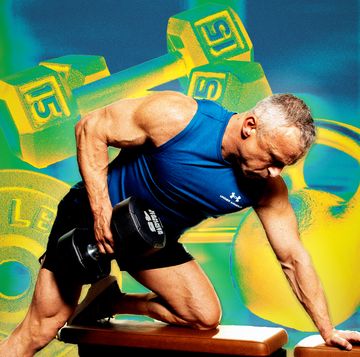
Gregg Avedon is one of the most recognisable faces in men's fashion.
Having modelled for brands including Giorgio Armani, Dolce & Gabbana and Valentino, he's worked with many of the biggest names in the industry. He's also appeared on more Men's Health covers than any other model – a distinction he adds to this month with his latest cover appearance for Men's Health Spain.
We caught up with Avedon to discuss training, ageing, modelling and the fitness philosophy that's kept him in remarkable shape at 60.
What does it feel like to be considered one of the magazine's icons?
When I think about all the travelling I've done as a model, one of the things that still surprises me most is how often people recognise me from Men's Health. I'm proud to represent the brand and honoured to be considered one of its icons.
Do you remember your first cover?
Absolutely. It was shot in Europe in a freezing-cold studio. They put me inside a huge tub while an assistant stood on a ladder out of shot pouring freezing water over my head. I was just trying not to look ridiculous. Apparently they loved the photos because a few months later I was back shooting for the magazine again.
How many covers have you appeared on worldwide?
Around 50 if you count every edition. More than half of those were in the US.
What to read next

From Skinny Teenager to Fitness Icon
Were you always athletic growing up?
Not at all. I was very skinny as a teenager and struggled to put on muscle. In hindsight, that was probably a blessing because it forced me to focus on building quality muscle without gaining much body fat.
I discovered the gym at 15 and by 17 I was completely hooked. I entered my first teenage bodybuilding competition and still remember the excitement of seeing my photo published in a local magazine afterwards. Becoming a fitness icon wasn't even on my radar at that point.
What first drew you to weight training?
I originally wanted to play American football, but I simply wasn't big enough. Every game felt like I was getting beaten up.
Then I walked into a weights room for the first time and something just clicked. It felt like someone had turned on a light. I knew immediately I'd found what I wanted to do.
That eventually led to bodybuilding competitions?
It was a natural progression. Like everyone else at the time, I wanted to be Arnold Schwarzenegger.
I ended up competing 22 times and learned an enormous amount. One of the more unusual experiences was performing in a travelling bodybuilding show that toured cruise ships and fairs. We had giant twin bodybuilders doing routines, while I performed an Adam-and-Eve themed routine with another performer. Looking back, it was a brilliant experience.
Gregg Avedon's Men's Health Spain Covers

February 2017

April 2003

July/August 2005

August 2003

May 2004

January 2003
How a Chance Encounter Changed Everything
How did modelling happen?
Completely by accident.
An agent approached me in a shopping centre and asked if I was a model. I said no. She asked whether I'd ever considered it. Again, no.
She handed me a card and told me to call if I changed my mind.
A couple of weeks later I'd graduated with a graphic design degree and was struggling to find work, so I gave her a call. Within weeks I was signed to one of the biggest agencies in Miami. Soon after that I was working in Paris and Milan for Versace, Armani, Dolce & Gabbana, Valentino and many others. Everything happened incredibly quickly.
Your physique hasn't changed much in decades. What's your training routine like today?
My training routine hasn't changed in more than 20 years because it works.
I train six days a week using a three-day split. Day one is chest and shoulders, day two is back and arms, and day three is legs. Then I repeat the cycle. I also include core work in every session, usually nine sets spread throughout the workout.
People often think you need to constantly reinvent your programme, but consistency is what delivers results. If someone needs training or nutrition advice, I'm always happy to help through Instagram at @greggavedon.

The Exercises He Swears By
Do you have any favourite exercises?
Some of my favourites include Romanian deadlifts, dumbbell bench presses, lateral raises from different angles, bent-over dumbbell rows, barbell curls and hammer curls. Honestly, I enjoy most exercises.
What interests me most is finding new ways to challenge a muscle. That could mean manipulating tempo, increasing time under tension, slowing down part of a repetition, reducing rest periods, adding isometric holds, supersets, giant sets, drop sets or pyramid sets.
Those techniques can completely transform an exercise you've been doing for years. In a typical one-hour workout, I might complete 50 sets and more than 600 reps. That's probably the Arnold influence coming out in me.
Are there any exercises you avoid?
The only exercises I dislike are those that carry an unnecessary risk of injury.
Heavy squats, heavy conventional deadlifts and very heavy overhead presses can put a lot of stress on the lower back, knees and shoulders. As you get older, staying healthy becomes more important than proving how much weight you can lift.

His Approach to Diet at 60
How strict are you with your nutrition?
I'd say I'm strict about 90% of the time.
Most of my diet is built around leafy greens and colourful vegetables – things like peppers, carrots, tomatoes, broccoli and spinach. I eat fruit regularly, have an avocado every day, use extra-virgin olive oil and often snack on plain Greek yoghurt.
For protein, I largely avoid red meat and stick to fish, chicken and turkey. I'll also have pasta or rice roughly once every 10 days to help replenish glycogen stores and support training.
Of course, I still enjoy foods like ice cream, cake, pastries and crisps – I just don't eat them very often.
The Biggest Lesson He's Learnt
After decades in bodybuilding, modelling and fitness, Avedon's message remains remarkably simple.
'The most important thing I'd tell people is that it's possible to build the body you want,' he says. 'With hard work, dedication, consistency and good nutrition, you can create a physique you're proud of.'
For someone who has appeared on around 50 Men's Health covers worldwide, that's advice worth listening to.

If there’s one thing Kori Sampson knows, it’s how to optimise your body composition for performance. To tap into his knowledge as an elite athlete and coach, we asked him to create a 4-week plan to help you move faster, recover quicker and keep pushing when the fatigue sets in – all while improving your muscle-to-fat ratio.
Ready to build muscle, burn fat and come out the other side looking, feeling and performing better? Click here to get 14 days of free access to the plan via the Men’s Health app.