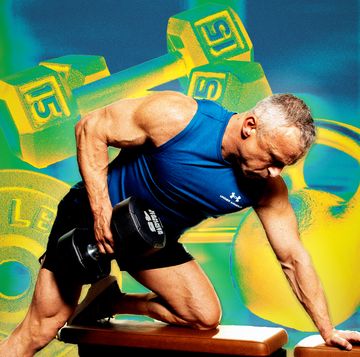
Over 50 and want to see how your fitness stacks up against others in your age group? Well, it's your lucky day. Bryan Mataya, who runs the @bfitover50 Instagram account and coaches busy men, has shared seven longevity standards that every man over 50 should aim for.
‘They measure strength, muscle mass, balance, mobility, grip strength, cardiovascular fitness and relative strength,’ he says. ‘The exact qualities that tend to decline with age if you don’t train them.
‘At 59, my goal isn’t just to live longer. My goal is to stay strong, lean, sharp and independent for as long as possible. Because what’s the point of adding years to your life if you can’t fully enjoy them?’
It's worth noting that these tests are weighted more heavily towards strength than cardiovascular fitness, and they won't necessarily suit every individual. Some of the standards are ambitious, while others apply blanket figures that don't account for differences in height, bodyweight, training history and previous activity levels.
That said, they still provide useful benchmarks if your goal is to become one of the fittest men in your age group. And if you're currently some way off these targets, there's still plenty of time to improve.

Goblet Squat 50% of Your Bodyweight for 20 Reps
Holding a single kettlebell or dumbbell in both hands, perform as many squats as you possibly can before your legs, core, or arms give out.
This is a useful test because it assesses more than just leg strength. Your core, upper back and arms all have to work hard to stabilise the weight throughout the set.
The challenge is also heavily biased towards muscular endurance. Twenty reps with half your bodyweight is demanding, particularly as fatigue begins to accumulate.
Why it's Important
A long-term study of highly active older adults found that knee extension strength declines by roughly 5% per year after the age of 40, while running alone wasn't enough to prevent age-related strength loss.
That reinforces the importance of resistance training, with the goblet squat serving as a useful benchmark that places relatively little stress on the lower back.
Carry Your Bodyweight for 2 Minutes
The farmer's carry is the most common way to test this standard, although 2 minutes is an extremely demanding target.
In fact, even experienced gym-goers may struggle to hold on for that long. MH benchmarks suggest that an intermediate carry time for men aged 50-59 falls somewhere between 20 and 75 seconds. Two minutes would generally be considered elite.
Why it's Important
Grip strength is strongly associated with healthy ageing and a lower risk of mortality.
Being able to carry your bodyweight for an extended period also suggests you regularly strength train, allowing you to reap the benefits that come with maintaining muscle and strength as you age.
Perform 10 Strict Pull-Ups
Mataya sets an ambitious benchmark here.
Ten strict pull-ups is a lot, particularly when you consider factors such as bodyweight and limb length. Heavier men often find pull-ups significantly harder than lighter men, regardless of training experience.
MH fitness director Andrew Tracey also believes that any man capable of performing a single strict pull-up is already ahead of the majority of the population.
‘Upper-body pulling strength is one of the first qualities to slide when training becomes inconsistent,’ says Tracey.
‘Pull-ups are a great test of relative strength, that is: strength in relation to your bodyweight. I’m fond of saying that they "keep you honest". Improve your body composition, train your lats, biceps and mid-back intelligently, and your numbers will climb.’
Why it's Important
Pull-ups simultaneously test body composition, grip strength and upper-body strength, making them one of the most effective indicators of relative strength.
Get Down to the Floor and Stand Back Up Without Using Your Hands
Otherwise known as the Sitting-Rising Test (SRT), this is arguably the most practical benchmark on the list.
Starting from standing, lower yourself to the floor under control before returning to standing without using your hands for support.
Why it's Important
Research has found the Sitting-Rising Test to be a significant predictor of mortality among adults aged 51-80.
Success is influenced by a combination of strength, balance, coordination and flexibility, making it a useful indicator of overall physical function.
Perform 40 Unbroken Push-Ups
Push-ups remain one of the simplest tests of upper-body endurance and strength.
Forty consecutive reps is also a benchmark that's received attention after Harvard research suggested it may be associated with better cardiovascular health.
That said, push-up performance is highly trainable and doesn't necessarily reflect every aspect of fitness. It's best viewed as one piece of the puzzle rather than the ultimate marker of health.
Why it's Important
The Harvard study found that firefighters capable of performing more than 40 push-ups had a 96% lower risk of cardiovascular disease than those who could complete 10 or fewer.
Dead Hang for 2 Minutes
This may be the most ambitious standard on Mataya's list.
As with pull-ups and carries, bodyweight plays a major role. Lighter men generally have an advantage, while grip strength and training history also influence performance.
Still, a 2-minute dead hang remains an impressive feat.
Why it's Important
Grip strength continues to emerge as one of the strongest indicators of healthy ageing and longevity.
The dead hang also develops shoulder stability, forearm endurance and core strength, making it a surprisingly comprehensive exercise.
Run a Mile in Under 10 Minutes
Depending on your training background, this may be the most achievable standard on the list.
Running is challenging regardless of distance, but many men can work towards a sub-10-minute mile with consistent training. For more experienced runners, even faster times may be realistic.
Why it's Important
Research from the Cooper Institute suggests that men over 50 who can run a mile in under 8 minutes tend to have superior long-term health outcomes, while mile times slower than 12 minutes are associated with higher health risks.
The mile remains one of the simplest and most accessible ways to assess cardiovascular fitness.
If there’s one thing Kori Sampson knows, it’s how to optimise your body composition for performance. To tap into his knowledge as an elite athlete and coach, we asked him to create a 4-week plan to help you move faster, recover quicker and keep pushing when the fatigue sets in – all while improving your muscle-to-fat ratio.
Ready to build muscle, burn fat and come out the other side looking, feeling and performing better? Click here to get 14 days of free access to the plan via the Men’s Health app.

Ryan is a Senior Writer at Men’s Health UK with a passion for storytelling, health and fitness. Having graduated from Cardiff University in 2020, and later obtaining his NCTJ qualification, Ryan started his career as a Trainee News Writer for sports titles Golf Monthly, Cycling Weekly and Rugby World before progressing to Staff Writer and subsequently Senior Writer with football magazine FourFourTwo.
During his two-and-a-half years there he wrote news stories for the website and features for the magazine, while he also interviewed names such as Les Ferdinand, Ally McCoist, Jamie Redknapp and Antonio Rudiger, among many others. His standout memory, though, came when getting the opportunity to speak to then-Plymouth Argyle manager Steven Schumacher as the club won League One in 2023.
Having grown up a keen footballer and playing for his boyhood side until the age of 16, Ryan got the opportunity to represent Northern Ireland national futsal team eight times, scoring three goals against England, Scotland and Gibraltar. Now past his peak, Ryan prefers to mix weightlifting with running – he achieved a marathon PB of 3:31:49 at Manchester in April 2025, but credits the heat for failing to get below the coveted 3:30 mark…
You can follow Ryan on Instagram @ryan.dabbs or on X @ryandabbs_