If you keep up with the industry, it can feel like watchmakers are always championing an exotic new material from which they’ve crafted their latest timepiece. The Earth’s crust and the outer reaches of the periodic table are routinely plundered in the name of turning up a slightly tougher metal alloy or a more vividly decorative dial. Even materials from outer space are fair game, with meteorite dial inlays highly prized by collectors. And we haven’t even got to the myriad polymers that can be dreamed up in labs across Switzerland. Whatever went wrong with stainless steel?
The short answer is: nothing. But there is a metal that represents a proper upgrade on steel without leaving you feeling as if you’ve been bamboozled by marketing spiel. Titanium has been around in watchmaking for over half a century, starting with the Citizen X-8 from 1970, but it can feel like a 21st-century innovation. It’s laborious to machine, so no one was producing titanium watches in serious volumes until much more recently.
Technological advances have made it easier to produce watch cases and bracelets in the metal. Naturally, its strength is the main reason it’s so sought-after. Grade 5 titanium – the most commonly used alloy – is roughly twice as tough as stainless steel. It’s also hypoallergenic and less sensitive to heat – all qualities you’d welcome in a watch. And titanium’s suitability for making sports-style watches was given a boost when Rolex introduced its first titanium production model. Often, you’ll find titanium watches given a matte texture that befits the metal’s utilitarian qualities, but it can be polished (at great effort) to the point where it’s almost indistinguishable from steel. Finished in this way, a titanium watch is a stealth upgrade.

Bell & Ross BR-X5 Racing
A 500-piece limited edition that pays tribute to the lightweight engineering so keenly prized in motorsport and aviation, this watch also uses carbon fibre in its bezel. The semi-transparent dial reveals the chronometer-certified movement beneath. £10,300

Christopher Ward C60 Trident Lumière
The Trident has been Christopher Ward’s flagship dive watch for 15 years, but the latest version, with a 41mm grade 2 titanium case, might just be the one that sees it step out from the shadow of longer-established designs. The 3D luminous hour markers are a highlight. £1,985

Grand Seiko SLGA025
Grand Seiko prides itself on the brightness of its ‘high-intensity’ titanium, an undisclosed alloy that can be polished to a brilliant shine. It’s a good pairing for the 40mm SLGA025’s shimmering dial, which is inspired by the waters of the Atera River that flows through central Japan. £9,600

Breitling Chronomat B01 42
Breitling’s Chronomat, at 42mm across and 15mm thick, is a perfect example of titanium making larger watches more wearable: even on this distinctive tubular bracelet, inspired by a model from 1984, the entire watch weighs just 152g. Inside is Breitling’s in-house automatic chronograph calibre, the B01. £9,850

Longines Spirit Zulu Time
Named after the military convention of referring to UTC with a Z (or Zulu) , this 39mm watch nods to Longines’ history making pilots’ watches, but doesn’t belabour the point, so anyone simply wanting a watch that can track two time zones needn’t feel like they’re not Top Gun enough. £3,900

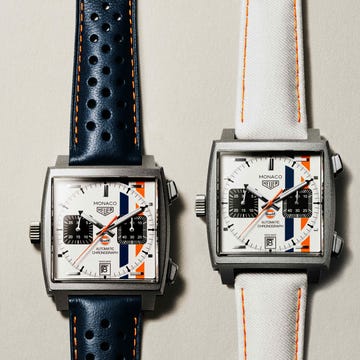
Tag Heuer Monaco
Also measuring 39mm across, but in reality a larger watch thanks to its slab-sided square case, the Tag Heuer Monaco benefits from a lighter case, while the sandblasted finish brings the 1969 design up to date. Grade 2 titanium – a purer alloy – is preferred over grade 5. £7,050