The Secret to Picking Your First Set of Golf Clubs
Sets from Callaway, Stix, and more offer solid, affordable clubs.
 Reviewed by Ryan BrowerSenior Gear and Reviews Editor
Our product picks are editor-tested, expert-approved. We may earn a commission through links on our site. Why Trust Us?
NO MATTER WHEN you started the sport of golf, there will be a time in your life when you need to invest in a golf club set. As it’s a lifetime sport, it’s best to invest in a decent setup, and if well maintained, it can last you for years to come.
Best Golf Clubs for Beginners
- Best Overall Golf Clubs: Callaway XR 13-Piece Complete Set
- Best Value: Wilson Profile Complete Set
- Best for Absolute Beginners: Precise Top Line M5 Golf Club Set
- Best for Lots of Play: TaylorMade RBZ Set
- Best for Rapid Improvement: Stix Golf Perform Series
- Best for Carts: Cobra Fly XL Golf Set
It's true you could go buy pre-owned clubs as your first beginner set, which is not a bad idea to peruse your local Dick's Sporting Goods or local golf shop (especially for previous year model demos), brand sites' used portals like Callway Certified Pre-Owned, or Ebay. But if you've gotten the golf bug and are looking for a new-to-you set, these days golf brands are churning out shiny, high quality sets at affordable entry points. Customization is also better than ever, as several outfitters offer club length adjustments, different club combinations, and a selection of stylish golf bags to accompany them. You can always ask for a set as a great golf gift, too.
Whichever route you chose, we spoke with Paul Silva, head pro at NYC’s Van Cortlandt Golf Club to answer some of the most frequently asked questions when it comes to buying a beginner golf set. After you get a legit set, don't forget about some golf shoes.
What to Consider
Number of Clubs/Set Configuration
Most beginner sets will include between nine and 11 clubs. 10 is a good sweet spot; it is enough to have a driver, a fairway wood and/or a hybrid, a 5i-9i, a wedge, and a putter. Generally a full set is 14 clubs, that includes the putter.
Two recommendations we would make would be to forego a 3-wood in favor of a 5-wood or 4-hybrid—most players don’t actually need a 3-wood and would be better served with a more forgiving hybrid (or two). If you can, consider adding a sand wedge (or potentially a lob wedge that you learn how to use) to sit alongside your pitching wedge, as many pitching wedges aren’t lofted enough for tricky shots in the sand or around the greens.
As Silva told us, "I tell everyone the same thing in the beginning, find a few clubs that you can hit—a hybrid, a 5 iron, a 7 iron, a pitching wedge, a putter. You can learn to do a lot with those things, especially in the beginning. You don’t need to worry so much about distance."
Shaft
Most beginners will want a shaft made of graphite. These will create greater swing speeds, allowing you to hit the ball further, even as you start to tune your swing. If you’re not a full-on beginner or aren’t looking for any extra distance, a set with steel shafts are a great choice. These will be easier to grow into skill-wise, making it easier to adapt as your game improves. As your swing speed improves, the flex of graphite shafts will be too much, and you’ll need to graduate to iron shafts then.
Forgiveness
The main factors in forgiveness are club head and shaft. There’s a lot to dig into with this (we could write an entire essay on these two things), but in general, most beginner sets are outfitted with the absolute easiest club head to hit and a graphite shaft that allows for greater swing speed and fewer mistakes. We’d say not to get caught up in the nitty gritty and focus on finding a set that is made for new players—something that almost every brand will outline in its product descriptions. Make sure you take a look to see what handicap each club set is designed for and pick the one made for high handicappers (that’s you), as these are coined as player improvement clubs.
Budget
Golf club prices run the gamut, but a good set of beginner clubs will usually run you anywhere from $250-$1,000. This is a huge discrepancy, but there is a big range in quality from bottom to top. If you’re a brand new golfer, spending $1,000 isn’t necessary, but if you think you’re in it for the long haul and want a set of sticks that are going to allow you to progress without having to upgrade, spending a little more cash is a great idea—the technology really does make a difference and it'll save you with an upgrade in a year or two if improve.
How We Selected
To help facilitate the best golf club sets on the market in 2026, I consulted with Senior Gear and Commerce Editor Ryan Brower (a mid-handicapper himself) to determine which clubs available are truly worthwhile. We evaluated each on club head size, materials, shaft construction, and forgiveness. Some sets, like the Stix full setup, gave us the chance to see what a quality set of clubs can do for a high handicapper, while the more affordable sets gave us a good idea of what is possible at a low price point.
Even for someone like me, who may only get on the links a couple of times a year, using any of the sets listed below can have an instant improvement in gameplay. Brower typically plays around 20 rounds per year, so he definitely knows his way around a course. Ultimately, we picked sets that we liked the most, but there are so many options today, you really can’t go wrong when you’re trying to make a decision, because, hey, you can always upgrade. Here are the best golf club sets we've found in 2026.
Callaway Golf 2026 XR 13-Piece Complete Set

Callaway Golf 2026 XR 13-Piece Complete Set
Pros
- Clubs made by some of the best and biggest names in golf
- A full set with two hybrids makes these one of the most versatile in the bunch
- Technology designed to add distance and improve forgiveness no matter the lie
- Comes with an Odyssey mallet putter

Cons
- Is equally as expensive as many top-of-the-line sets

When it comes to the game of golf, not many brands can boast expertise in every single category. One that can though is Callaway. The brand behind elite golf balls, top-tier putters, golf bags, pro-worthy irons and drivers, Callaway is no slouch when it comes to making high-quality gear for beginners.
The 2026 XR lineup comes in a 13-piece set, which includes a mallet putter made by Odyssey and its DFX V-line Fang shape, which offers higher stability and more aggressive alignment aids—two elements you’re rarely going to find in an entry-level putter. The irons are classics, based on decades of stellar game-improvement technology, while the hybrids, 3 wood, and driver are modeled after one of golf’s most exciting new weapons of the past couple of years, the Paradym. T his year you also get an approach wedge. Add on the fact of its high-MOI V-Line putter and you get a set that dominates the short game. This set will set you back more than most, but don’t be surprised if you tote these clubs along with you for the next ten years.
Read More: The Best Golf Shirts
| Total Number of Clubs | 12 |
| Clubs Included | Driver, 3 Wood, 4 Hybrid, 5 Hybrid, 6i, 7i, 8i, 9i, PW, AW, SW, Putter |
| Golf Bag Included? | Yes |
Wilson
Profile Platinum Complete Package Set
Wilson
Profile Platinum Complete Package SetPros
- Under $500
- Comes with comfortable bag
- Durable clubs that will hold up over time
- Irons stand out in performance when you consider the price you pay
Cons
- Will likely want to upgrade the driver and putter as you play more
Though technically a slightly older legacy bundle, this platinum set features two premium features we love. The first are the irons. They're well-built and just what you want out of a beginner iron, making them a solid set to build the base of your arsenal for years to come. Considered a game improvement set, they have a thinner top line and are more refined. The second is the golf bag: It's highly comfortable thanks to the dual carrying strap and lightweight design, and comes with ample pocket space.
Wilson is a brand with immense golf pedigree—no player worth their salt will scoff at the brand’s gear, whether you’re shooting even par or twenty-over. The set is immensely affordable, so while it will probably long outlast your golf career, it won’t make you feel bad about upgrading once you start to improve.
Read More: Best Golf Clubs on Amazon
| Total Number of Clubs | 10 |
| Clubs Included | Driver, 5 Wood, 5 Hybrid, 6i, 7i, 8i, 9i, PW, SW, Putter |
| Golf Bag Included? | Yes |
Precise Top Line Men's M5 Golf Club Set

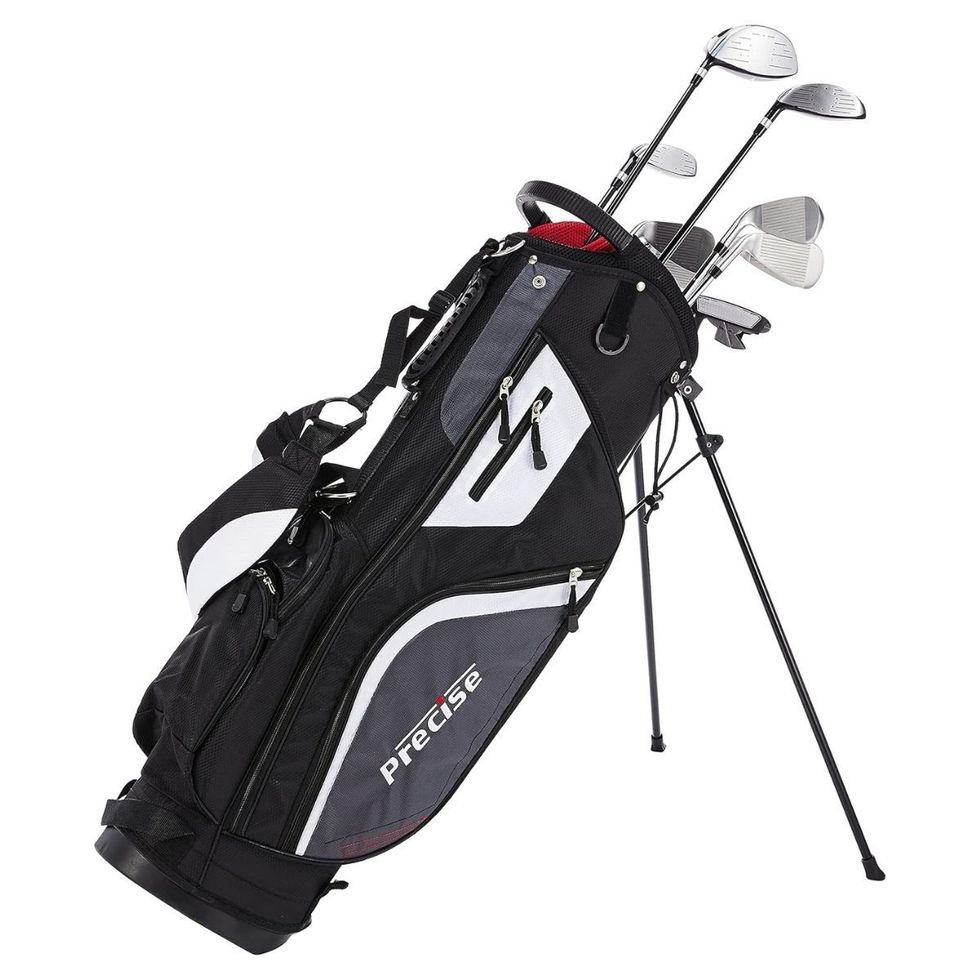
Precise Top Line Men's M5 Golf Club Set
Pros
- An ultra-affordable price point
- Comes with all the clubs you need to get from tee to green
- Available left handed, right handed or right handed tall (+1”)
Cons
- An avid player will outgrow this set quickly
- Won’t last as long as a set with higher quality construction
For someone just getting into the game or hitting the range for the very first time, this set is great to start with. With every club you’ll need to get from the tee box to the green (and probably everywhere in between), this set won’t leave you without an option, no matter how wayward your shots get.
The set has a solid 4.3 out of 5 star rating on Amazon, with reviewers lauding the set’s value and high level of forgiveness. Odds are high you’ll want to upgrade sooner than later, but if you or someone you know likes to pick up new hobbies, this set will help decide if golf is a lifelong commitment or just a phase.
| Total Number of Clubs | 10 |
| Clubs Included | Driver, 3 Wood, Hybrid, 5i, 6i, 7i, 8i, 9i, PW, Putter |
| Golf Bag Included? | Yes |
TaylorMade RBZ Complete Set

TaylorMade RBZ Complete Set
Pros
- High quality set you won’t grow out of too quickly
- Modeled after sets used by real-world PGA pros
- Appealing club and bag design
Cons
- Requires significant investment
- Doesn't include a 5-wood
While one of the most expensive of the bunch, this TaylorMade set is certifiably legit. We're talking about a beast of a driver which features an adjustable driver, allowing you to change the loft and face angle as your swing evolves (something you hardly ever find on a complete set driver), a beautiful set of high-performance irons, and a stylish golf bag that will protect your investment with reassurance.
This is a set for those who are getting serious and playing several times per week. The barrier to entry is higher than the rest of the options on our list, but when you consider the pedigree of a brand like TaylorMade, you’ll find that the long lifespan of the clubs and golf bag make it a set you can grow into and not have to replace for years.
Read More: Best Golf Gifts
| Total Number of Clubs | 10 |
| Clubs Included | Driver, 3 Wood, 4 Hybrid, 6i, 7i, 8i, 9i, PW, SW, Putter |
| Golf Bag Included? | Yes |
Stix Golf Perform Series
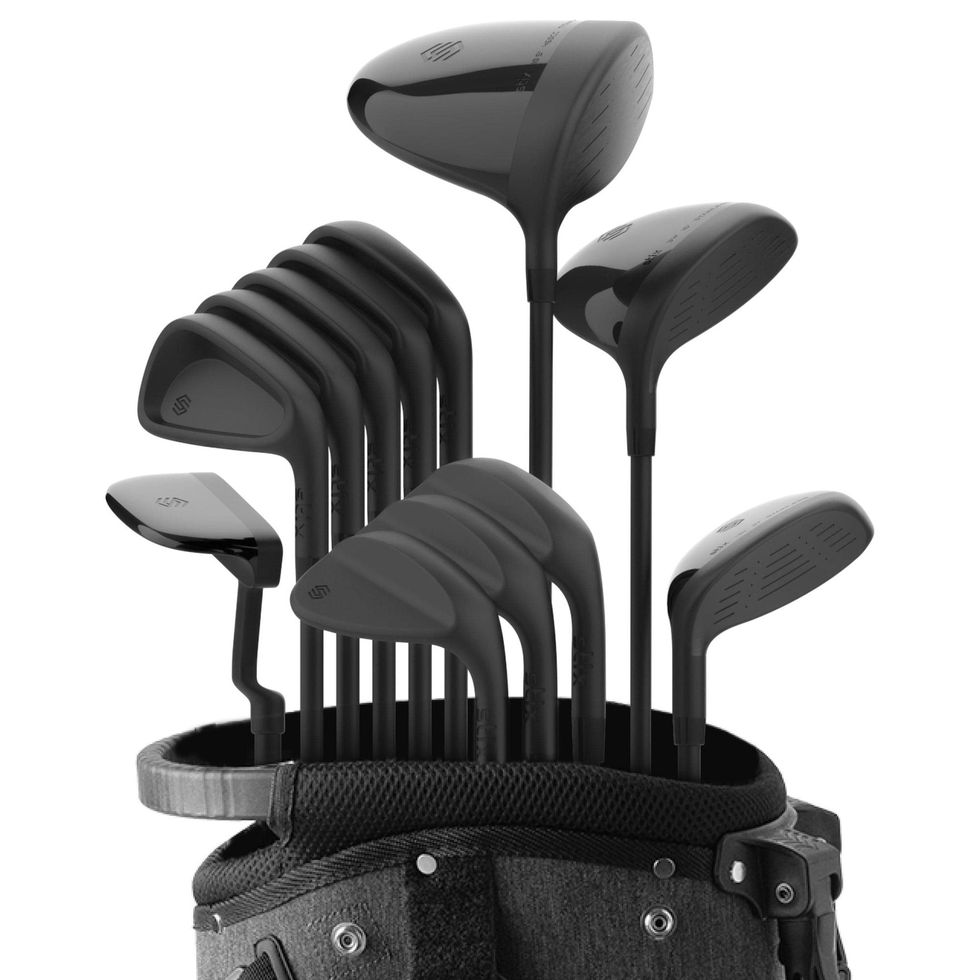
Stix Golf Perform Series
Pros
- Available for left and right hand
- Solid price point when you consider total value
- Irons come with steel or graphite shafts
- Sleek, modern style that won a Red Dot Award in 2022
Cons
- The included bag could be sturdier
Picking up on the game quicker than you thought? You can skip the early stages and go for a complete set that allows you to learn how to optimize your shot-making skills. The Stix Perform Set is a complete 12-club set that will provide you with all the tools you need, all for under $1,000.
The Perform Set is the brand’s first set with the option for irons with a steel shaft, a boon for mid-high handicap players whose higher swing speeds may be a bit too much for the extra flex of graphite. Clubs that benefit from the flex (the driver, 3 wood, and 4 hybrid) still come standard with graphite, but having the choice when selecting irons is going to greatly increase the amount of time you’ll stick with your Stix.
In my testing, I took the Stix out for a couple dozen rounds, walking and riding in a cart. The set is very manageable size-wise. The bag is light enough for comfortable wear but big enough to stay secure when strapped to the back of a golf cart. They’re some of the most forgiving clubs I've played and are well-built, resulting in improved distance and fewer mishits. My favorite club was the 4 iron hybrid—I've never hit a hybrid so well.
| Total Number of Clubs | 12 |
| Clubs Included | Driver, 3 Wood, 4 Hybrid, 6i, 7i, 8i, 9i, PW, 52° Wedge, 56° Wedge, 60° Wedge, Putter |
| Golf Bag Included? | Yes |
Fly-XL Cart Bag Complete Set

Fly-XL Cart Bag Complete Set
Pros
- High quality cart bag is spacious and durable
- Multiple hybrids improve distance and versatility in the mid-range game
- Cobra is one of the top names in golf equipment
Cons
- Bag is not made for walking
- Still on the pricey side.
Another set from one of the most prestigious equipment brands in golf, the Cobra Fly XL set is the ideal set for someone who knows they’re going to be consistently hitting the golf course in a golf cart. The cart bag is big, sturdy, and spacious, while the wide range of clubs gives you options in every part of the course.
The Cobra brand is well-recognized, and these striking clubs will fit in with any other sets on the course, ensuring that your skills do the talking, not your equipment. If your skills are lacking, that’s okay, too, because each club in this set is super forgiving thanks to excellent weight distribution and optimized shape, from the driver right down through the putter.
| Total Number of Clubs | 11 |
| Clubs Included | Driver, 3 Wood, 4 Hybrid, 5 Hybrid, 6i, 7i, 8i, 9i, PW, SW, Putter |
| Golf Bag Included? | Yes |
PXG
Wildcat Full Bag Bundle
PXG
Wildcat Full Bag BundlePros
- High-loft 16-degree driver
- Premium polymer-filled irons
- Hellcat ZT putter is gorgeous
Cons
- Most expensive set in our guide
- Some may not like the driver's loft
- Only 9-club set
When you’re looking for a little more performance but still trying to stay affordable, PXG is a brand to look to. This Wildcat Bundle is an extremely versatile setup, which utilizes premium materials and the same tech found in the brand’s standalone clubs, all tuned for maximum forgiveness and easy launch—must-haves for beginners.
While it is a hefty investment, they’re the one-and-done purchase type, meaning that you won’t outgrow them anytime soon, and will last for years to come. These clubs are meant to bridge the gap from big box store generic clubs and a custom-fitted pro set, while providing a fairway friendly driver and the brand’s polymer cores for a softer feel and more distance. While it’s only a 9-club set, it has all the essentials you’ll need to make it up and down on any course.
| Total Number of Clubs | 9 |
| Clubs Included | Driver, 5 Wood, 6 Hybrid, 7i, 8i, 9i, PW, SW, Putter |
| Golf Bag Included? | Yes |
Meet the Expert
- Paul Sliva is the Head Golf Professional at Van Cortlandt Golf Course in the Bronx, the oldest public golf course in the U.S.
Frequently Asked Questions
How to Find the Right Size of Golf Clubs
Beginners to golf do not need get a custom fitting for clubs, but if you have the money and want to go all in on your new hobby then we won't stop you. Really the main measurement you want to get right when buying is proper club sizing (not too tall or too short)— and the good news is most of these clubs will have a solid fit for just starting out.
The only initial adjustments you need to make as a beginner is if you are exceptionally tall or short. If you are over 6'2" consider sizing a half-inch or more length adjustment on your clubs. You can also just opt for a set that has a "Tall" option available. If you are under 5'5", you'll likely want a half-inch decrease in length adjustment.
If you like to go by feel, swinging your friends clubs or talking to a pro at your local course will help confirm the sizing you need. As you progress in your game, sizing can be pinpointed down further to personalized club sizing, if you choose.
Should I Buy Pre-owned Clubs?
There's nothing wrong with buying pre-owned clubs to serve as your first beginner set. There is a whole market online for really nice pre-owned clubs for a solid price on sites like Ebay and the golf brands' websites. Yet the downside is, you guessed it, they were somebody else's. There's wear and tear on them.
Instead of buying pre-owned, opt for new. A new set will give you the proper tools to get acclimated on the course and really give you the opportunity to learn the game. Golf is a lot about feel. Your clubs should be your best friend out on the course, not some raggedy set who's best days are long gone.
Buying a new set also gives you something to build off of. As you get better you'll want to make upgrades. Maybe you want a more precise sand wedge or a driver with more power? What you'll do next is swap out single clubs one at a time until you find a set that fits your game to a T.
Jeff Turbett is a fitness and wellness writer who's based in Miami, FL. His work has been featured in The Manual and FightCamp.

Will Porter is an LA-based freelance writer covering golf, tech, and travel. In addition to Men's Health, his work has been published in GQ, Gear Patrol, The Strategist, and others. When he's not writing, you'll find him running the trails at Griffith Park or trying to catch every new movie in IMAX at the local movie theater.
Ryan Brower is the Senior Gear and Reviews Editor at Men’s Health, where he tests the best products in outdoor gear and tech. Baseball, surfing, and camping occupied most of his time growing up. He also trained in martial arts for 12 years and holds a third degree black belt. He has written about the outdoors for nearly two decades and was previously the Managing Editor, Content Performance at Gear Patrol. He is also a Certified Beer Server and previously covered the craft beer industry. Ryan currently lives on the water in New Jersey with his wife and their dog.

Readers Also Read

Golf Bags That Will Instantly Upgrade Your Game

The Best Pickleball Paddles to Level Up Your Game

10 Best Golf Shoes to Bring Out Your A-Game

35 Golf Gifts Any Golfer Will Love