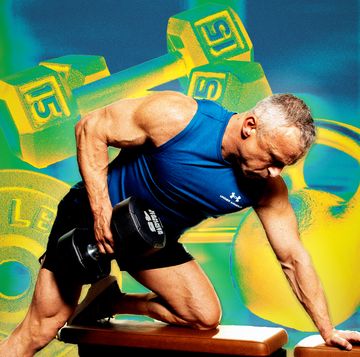
You probably already train hard in the gym, making sure you hit every muscle group with enough volume consistently. But building the muscles necessary for an aesthetic physique can take a more tailored approach.
According to coach Alain Gonzalez, the answer may not be training harder, but training smarter, especially for men over 40. In a recent video, Gonzalez broke down what he calls the 'Greek God method' – a training approach designed to build what's often known as an X-frame physique. That means broad shoulders, a tapered waist and wide legs.
'It's the shape people are picturing when they think of the Greek god physique,' says Gonzalez. 'And the best part is you don't have to build a ton of muscle to have it. You just need to know which muscles create it and how to build them.'

What Is the Greek God Method?
The Greek God Method focuses on developing the muscles that have the biggest visual impact. According to Gonzalez, many men assume a balanced training plan will naturally focus on these muscles, but that's not always true. Functional training and standard splits certainly have their place, but Gonzalez's method is more aesthetics-focused.
'Most guys believe that if they just keep training hard, follow a proven split and stay disciplined, they'll eventually develop a head-turning physique,' he says. 'But here's the truth. Balanced training will never build the X-frame.'
The method prioritises three key areas: the lats, the outer quads and the mid delts. 'We're not talking about the biggest muscles in your body or the ones that move the most weight,' says Gonzalez. 'We're talking about the ones that have the biggest visual impact on your physique because those are two very different things.'
What to read next
What Are the Benefits for Men Over 40?
For men over 40, Gonzalez says the method works because recovery is not unlimited. 'Your body has a limited capacity to recover from and adapt to training stress,' he says. 'And after 40, that capacity is even lower.'
By reducing non-priority work and filler exercises, and focusing on the lats, outer quads and mid delts, the method directs more effort towards the muscles that change how your physique looks. 'The Greek God method changes that by concentrating your effort where it actually shows,' he says.
How to Do the Greek God Method
To try the Greek God method, you don't need to overhaul your entire training plan. The aim is to prioritise the muscles that create the biggest visual change, while keeping the rest of your body ticking over.
You can start by making these three areas your focus and including some of the suggested exercises:
Lats: pull-ups or lat pulldowns
Outer quads: leg extensions or quad-dominant lower-body work
Mid delts: dumbbell lateral raises, cable lateral raises or cable Y-raises
For each of these priority muscles, aim for 8-12 hard sets per week, split across at least two sessions. Gonzalez recommends training them before fatigue builds and performance drops. 'Put them at the beginning of your workout when your energy is high,' he says.
The sets should be challenging. Take each one to, or close to, failure, using a weight you can control properly. For most people, Gonzalez recommends staying in the 8–12 rep range, rather than including very high-rep burnout sets that may add more fatigue than benefit. 'Stay in the 8–12 rep range where you're recruiting those high-threshold motor units earlier in the set and the recovery costs are still low,' he says.
Everything else should be reduced to maintenance volume. That means giving non-priority muscles around 2–3 sets per week, rather than trying to grow every muscle group at once. 'That's just enough to maintain what you've built while freeing up enough resources to grow your priority muscles more effectively,' says Gonzalez.
You can apply this to most training splits. For example, if you follow a push-pull-legs split, train side delts and lats first on push and pull days, then start leg day with quad-focused work. If you follow an upper/lower split, train delts and lats first on upper days, and begin lower-body days with quad-dominant exercises.
Follow the method consistently for 12 weeks, keeping the focus on quality sets, progressive overload, adequate nutrition and recovery, and you should start to see changes in your physique that are worth the effort.

If there’s one thing Kori Sampson knows, it’s how to optimise your body composition for performance. To tap into his knowledge as an elite athlete and coach, we asked him to create a 4-week plan to help you move faster, recover quicker and keep pushing when the fatigue sets in – all while improving your muscle-to-fat ratio.
Ready to build muscle, burn fat and come out the other side looking, feeling and performing better? Click here to get 14 days of free access to the plan via the Men’s Health app.